
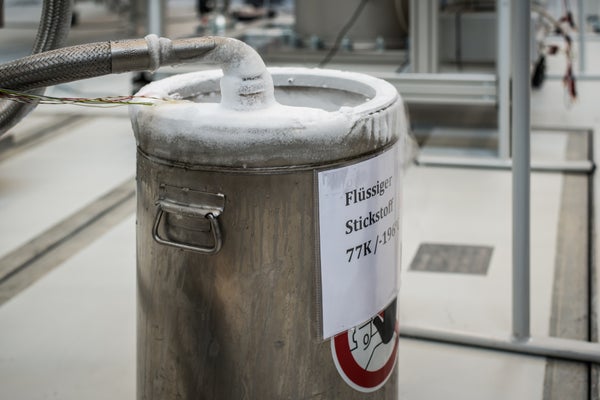
If scientists are to ever perfect the science of cryopreserving organs, they will have to succeed not only at protecting them at frigid temperatures, but also at bringing them back from their deep freeze.
With current warming methods, even small tissues tend to crack or crystallize as they are warmed, leaving them useless.
On Wednesday, however, researchers announced they had devised a technology that could rewarm larger pieces of tissue without major damage, paving the way for future studies that could demonstrate whether the method could be used to one day store organs for transplants.
On supporting science journalism
If you're enjoying this article, consider supporting our award-winning journalism by subscribing. By purchasing a subscription you are helping to ensure the future of impactful stories about the discoveries and ideas shaping our world today.
The research, published in the journal Science Translational Medicine, relies on seeding the tissue with nanoparticles that, when exposed to a magnetic field, activate into tiny yet powerful heat generators.
The study amounts to just a proof of concept, and the technology needs to be refined and scaled up before it could ever possibly rewarm something the size of a human organ rather than just small samples. But it points to a fascinating challenge for scientists: The technology of cryopreservation has advanced to the point where researchers can lock animal organs into a glass-like state—it’s getting them warm and usable again that’s the problem.
The research team, which was led by University of Minnesota scientists, is now trying to enhance the technology to see if it works on larger samples.
“We can actually see the road ahead,” said Kelvin Brockbank, a researcher at Clemson University and one of the coauthors of the paper.
Some experts not involved with the work were skeptical the method would ever be used in human transplants.
Dr. Paulo Fontes, a transplant surgeon at University of Pittsburgh Medical Center, acknowledged the technology was interesting, but said just because tissue was rewarmed successfully in a lab doesn’t mean it would function well after being transplanted into animals.
“They are not showing into detail what is happening with the cells, that the cells are intact, that the mitochondria are fine,” said Fontes, who also studies regenerative medicine. “There’s no functional assessment of this.”
Plus, Fontes said, the tissues were not left in their glassy state for all that long, and they are more likely to be damaged the longer they remain in those cold temperatures.
Others saw more potential in the approach.
“These sort of approaches always take longer than you would expect to reach clinical use,” said Dr. David Klassen, chief medical officer of the United Network for Organ Sharing, which manages the US transplant network. “Is this going to happen next year? No. But as a concept, it’s really interesting.”
There is already an organ shortage in the country. But even when organs are available for transplant, some fail to reach a matched recipient in time before becoming unusable.
If somehow donated organs that don’t immediately find recipients could be stored and shipped, “it would completely transform transplantation,” Klassen said.
For the study, the researchers focused on bringing back tissue that had been cryopreserved through a process called vitrification, which converts samples into a glassy state while preventing ice crystals from forming. They imbued the tissue with iron oxide nanoparticles that heated the samples uniformly and rapidly when triggered by a magnetic field. (The nanoparticles can be washed away after the tissue is rewarmed.)
The researchers ran experiments first to bring back human cells, and then pig arteries and heart valves. They found that they were able to rewarm samples of up to 50 milliliters in volume and almost entirely sustain their biological viability compared with samples that had not been preserved. Existing warming methods can only effectively heat samples of a few milliliters in volume.
Still, there is a long way to go. A kidney, for example, is about 450 to 500 milliliters in volume, experts said. That means the technology is more likely to be tried first with preserved heart valves before being used with whole organs, Brockbank said.
Researchers will also need to ensure the nanoparticles can be deployed uniformly throughout the organ, said John Bischof of the University of Minnesota, the senior author on the paper.
“If we’ve deployed enough of them … then you can begin to get the heating you want and need,” Bischof said.
The University of Minnesota has two patents on the heating method, and the group is collaborating with a company called Tissue Testing Technologies, where Brockbank is an executive.
Republished with permission from STAT. This article originally appeared on March 1, 2017