
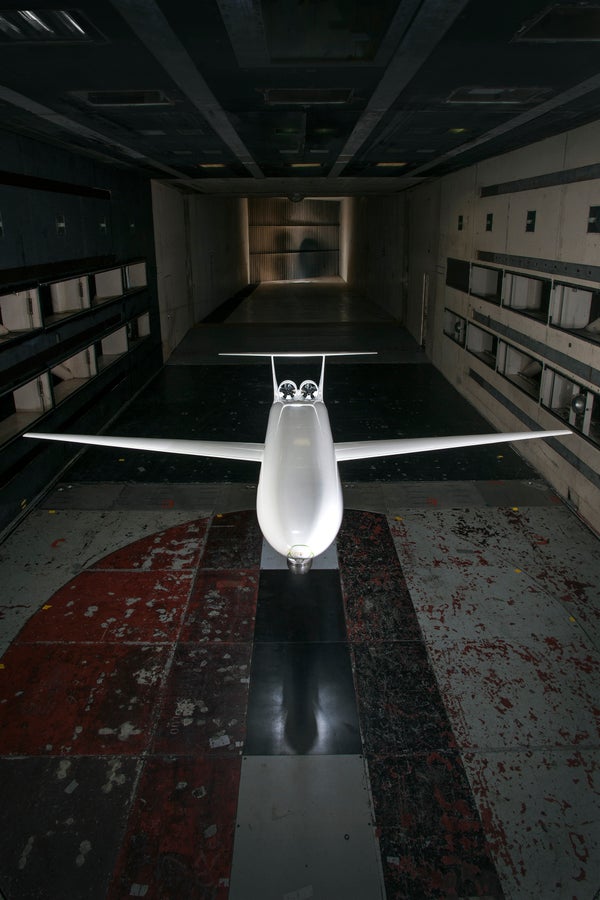
Airplane emissions are a big problem for the climate—and steadily rising. If the aviation sector were a country, it would rank seventh worldwide in carbon pollution. Experts predict that aircraft emissions, on their current trajectory, will triple by 2050 as demand for flights increases. To prevent this dire scenario, a team of scientists at the Massachusetts Institute of Technology, along with government and industry collaborators, is attempting to fundamentally redesign airplanes.
Their concept, dubbed the “double-bubble” D8, could significantly reduce aviation's carbon footprint and improve fuel efficiency if validated in full-scale tests. It entails major changes to the standard 180-passenger Boeing 737 and Airbus A320 aircraft—for example, the fuselage has a wider, more oval shape than a conventional jet. “It's like two bubbles [joined] side by side,” explains Alejandra Uranga, an assistant professor of aerospace and mechanical engineering now at the University of Southern California. This modification lets the fuselage itself generate some lift, says Uranga, who is a co-principal investigator for the project, alongside Edward Greitzer of M.I.T. The altered body shape allows the wings and tail to be smaller and lighter, and the aircraft's nose is also more aerodynamic.
The most significant change, though, is the engine position. Air slows down as it flows over the top of a conventional plane, thereby creating drag and making the craft less efficient. But the D8 design moves the jet's engines from their usual spot underneath the wings to atop the plane's body, by the tail—where they suck in and reaccelerate the slow layer of air, greatly reducing drag.
On supporting science journalism
If you're enjoying this article, consider supporting our award-winning journalism by subscribing. By purchasing a subscription you are helping to ensure the future of impactful stories about the discoveries and ideas shaping our world today.
These alterations would make the aircraft use 37 percent less fuel than a typical passenger jet, Uranga says. The project's chief engineer Mark Drela, Uranga, Greitzer and their collaborators at M.I.T., NASA, Aurora Flight Sciences and Pratt & Whitney have already built and tested an 11th-scale model of the aircraft in a NASA wind tunnel. Combining the new design with future technological advances could further reduce fuel use and ultimately add up to 66 percent in fuel savings in two decades, Uranga says.
Other experts note that the D8's developers must still overcome economic obstacles while ensuring that the engines are robust enough to handle the new configuration. Still, “it's a very compelling idea and design,” says Brian J. German, an aerospace engineer at the Georgia Institute of Technology, who was not involved in the work. Aurora is now exploring the development of a half-scale prototype plane. If the effort succeeds, travelers may fly in one of these jets as soon as 2035.