
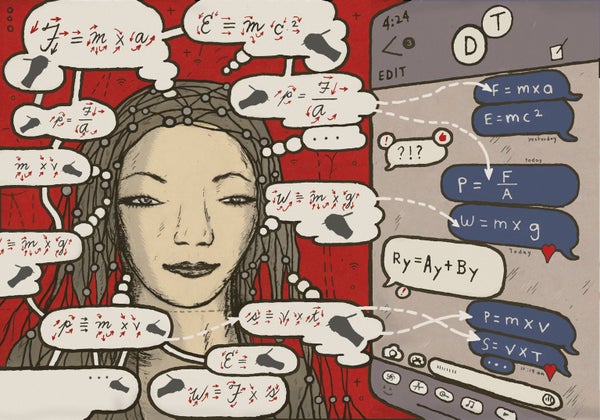
When you move, sense, speak, or do just about anything, your brain generates a specific corresponding pattern of electrical activity. For decades, scientists have run these impulses through machines to better understand brain diseases and help people with disabilities. Brain-computer interfaces (BCIs) under development can restore movement in some who have paralysis, and researchers are working on BCIs to treat neurological and psychiatric disorders.
The next frontier in BCIs, however, may be something more like writing a text message. A new study in Nature describes a brain implant that could let individuals with impaired limb movement create text using the mind—no hands needed.
For their study, the researchers coupled artificial-intelligence software with electrodes implanted in the brain of a man with full-body paralysis. He was asked to imagine himself writing by hand, and the BCI transformed his visualized letters and words into text on a computer screen. Such technology could potentially benefit millions of people worldwide who cannot type or speak because of impaired limbs or vocal muscles.
On supporting science journalism
If you're enjoying this article, consider supporting our award-winning journalism by subscribing. By purchasing a subscription you are helping to ensure the future of impactful stories about the discoveries and ideas shaping our world today.
Previous work by Krishna V. Shenoy of Stanford University, a co-senior author on the study, had helped analyze neural patterns associated with speech. His software also decoded imagined arm movements, so that those with paralysis could move a cursor around an on-screen keyboard to select and type letters. But this technique let people generate just 40 characters per minute, far lower than the average keyboard typing speed of roughly 190. The researchers’ new work sped up communication speed by using imagined handwriting. Their technique allowed the study subject, who was 65 years old at the time, to mentally type 90 characters per minute. That rate approaches the average for most senior texters, who can typically type about 115 characters per minute on a phone.
“This line of work could help restore communication in people who are severely paralyzed, or ‘locked-in,’” says Frank Willett, lead author of the paper and a research scientist at Stanford’s Neural Prosthetics Translational Laboratory. “It should help people express themselves and share their thoughts; it’s very exciting.”
The study participant had suffered a spinal cord injury in 2007, losing most movement below his neck. In 2016 Stanford neurosurgeon Jaimie Henderson, co-senior author of the paper, implanted two small BCI chips into the man’s brain. Each chip had 100 electrodes to sense neuron activity. They were implanted in a region of the motor cortex that controls hand and arm movements, letting the researchers profile brain-activity patterns associated with written language.
“This study is an important and clear advance for intracortical brain-computer interfaces,” says University of Washington bioengineer Amy L. Orsborn, who was not involved in the research. “One obvious reason why is because they achieved a huge leap in performance on a challenging but important task like typing. It’s also the most significant demonstration to date of leveraging established tools in machine learning, like predictive language models, to improve BCIs.”
Mijail D. Serruya, a neurologist at Thomas Jefferson University, who studies BCIs in stroke recovery but was not involved in the new study, is intrigued by the work. “I saw this research initially presented ... in 2019 and think it’s great,” he says. “I think it clearly shows that fine-motor trajectories can be decoded from neocortical activity.”
Serruya adds that his own research could align with Willett’s in helping those who have suffered brain trauma or a stroke. “We have shown that motor-control signals can be decoded [following a stroke], implying that some of the decoding approaches developed by Willett might have applications beyond people with spinal cord injury,” he says.
Yet Serruya also has a question about the new research, a hesitation he says he posed to Willett a few years ago: while restoring communication via written letters is intuitive, it may not be the most efficient means of doing so.
“Why not teach the person a new language based on simpler elementary gestures, similar to stenography chords or sign language?” Serruya asks. “This could both boost the speed of communication and, crucially, decrease the mental effort and attention needed.”
For now, Willett is focused on mentally decoding more familiar forms of communication—and he wants to repeat the typing experiment, involving more people with paralysis. Translating the brain’s control over handwriting may be a significant first step in restoring communication skills, he says. But decoding actual speech—by analyzing what someone intends to say—is still a major challenge facing researchers, given that individuals generate speech more quickly than they write or type.
“It’s been a hard problem to decode speech with enough accuracy and vocabulary size to allow people to have a general conversation. There’s a much higher signal-to-noise ratio, so it’s harder to translate to the computer,” Willett says. “But we’re now excited that we can decode handwriting very accurately. Each letter evokes a very different pattern of neural activity.”
As for when text-and-speech-decoding technology might be available to the public, Willett is cautiously optimistic. “It’s hard to predict when our method will be translated into a real device that anyone can buy,” he says. “There are companies working on implantable BCI devices now, but you never know when someone will succeed in translating it. We hope it’s within years, not decades!”