New Issue: Orbital Catastrophe Ahead? Read Now

New chicken-sized dinosaur baffles paleontologists

The tiny Foskeia pelendonum was a plant-eating dinosaur with a “weird” anatomy, scientists say

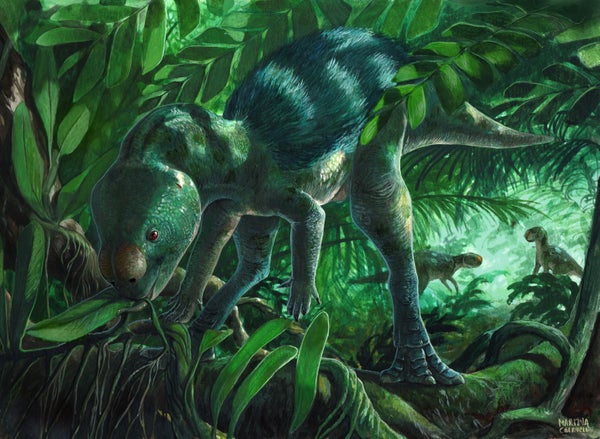
A small dinosaur with a wide, triangular head perched among bright green foliage

A reconstruction of the dinosaur Foskeia pelendonum.

Martina Charnell

Join Our Community of Science Lovers!

A tiny plant-eating dinosaur that was about the same size of a chicken and occupied what’s now northern Spain some 125 million years ago is baffling scientists.

The Early Cretaceous creature is described in a new paper published on Sunday in Papers in Paleontology.

The dinosaur, Foskeia pelendonum—named for the Greek words for “light” and “foraging”—was about half a meter long, with an unusual skull and teeth that suggest a “novel mode of feeding” behavior, the authors write.


On supporting science journalism

If you're enjoying this article, consider supporting our award-winning journalism by subscribing. By purchasing a subscription you are helping to ensure the future of impactful stories about the discoveries and ideas shaping our world today.


“Its anatomy is weird in precisely the kind of way that rewrites evolutionary trees,” said Penélope Cruzado-Caballero, an associate professor at the University of La Laguna in Spain and an author of the paper, in a statement.
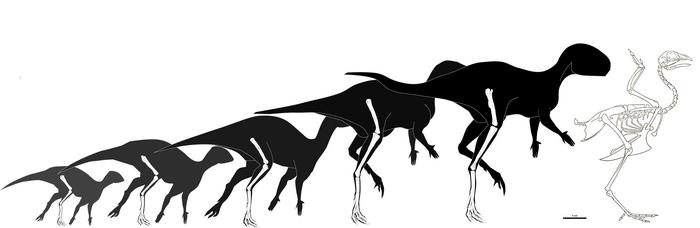
Shapes indicating the growth of Foskeia pelendonum in five sizes, ending just larger than a contemporary chicken

The growth trajectory of F. pelendonum compared with an adult chicken.

Dieudonné et al., 2026

The new species could help paleontologists better understand the lineage of the ornithischians, or “bird-hipped” dinosaurs.

“From the beginning, we knew these bones were exceptional because of their minute size,” said Fidel Torcida Fernández-Baldor, a co-author of the new research and director of the Dinosaur Museum in Salas de los Infantes, Spain, who first discovered the fossils, in the same statement. “It is equally impressive how the study of this animal overturns global ideas on ornithopod dinosaur evolution.”

Jackie Flynn Mogensen is a breaking news reporter at Scientific American. Before joining SciAm, she was a science reporter at Mother Jones, where she received a National Academies Eric and Wendy Schmidt Award for Excellence in Science Communications in 2024. Mogensen holds a master’s degree in environmental communication and a bachelor’s degree in earth sciences from Stanford University. She is based in New York City.

More by Jackie Flynn Mogensen

Subscribe to Support Independent Journalism

Great science journalism requires human expertise, time, effort and creativity. And it costs money. That’s why I and the journalists here at Scientific American hope you’ll join our community.

When you subscribe, you are supporting staff and freelance journalists who are passionate about telling science stories that are true, important and compelling. Our editors and reporters are often experts in their fields, which means they understand the nuances of big discoveries and can untangle the breakthroughs from the hype. With a subscription, you are also supporting rigorous fact-checking to ensure the words we publish are precise and accurate. And you’re supporting original illustrations, graphics and photos that bring you closer to an advanced laboratory, an ice sheet in Antarctica or a space mission in orbit. You’re helping us craft other types of high-quality journalism as well: Our newsletters are carefully written, edited and curated by staffers you have or will come to know and love. Our Science Quickly podcast is based on original reporting, collaboration with editors and scientists and exacting production.

Subscriptions keep this engine running so we can continue to deliver thoughtful, rigorous and independent science journalism to you. In an era of viral misinformation, this work is crucial. If you value what we do, I hope you’ll consider joining us as a subscriber

Thank you,

Jeanna Bryner, Editor in Chief, Scientific American

Subscribe