
Gravitational waves were detected for the first time a year and a half ago, when some of them throbbed through Earth. Two incredibly sensitive detectors—one in Washington State and one in Louisiana—picked up the distortions in spacetime, emanating in this case from two merging black holes. When scientists in charge of the detectors, called the Laser Interferometer Gravitational-Wave Observatory (LIGO), announced the finding five months later, it created an international sensation and became the most important physics news of 2016. Physicists had been hunting for decades for direct evidence of gravitational waves, first predicted to exist by Albert Einstein in 1916.
As impressive as the breakthrough was, it left some key questions unaddressed. Primary among them: Where was the source of the waves? If all goes as planned, scientists could soon be able to tackle this issue for future detections.
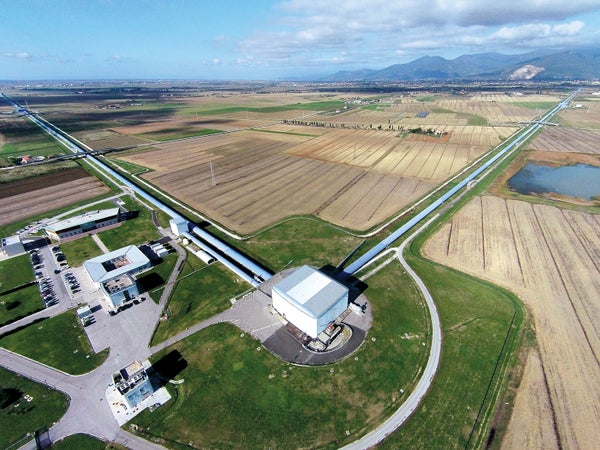
This spring physicists are gearing up to turn back on a third gravitational-wave detector, called Virgo, near the Italian city of Pisa. Virgo was offline and undergoing upgrades when LIGO received its two signals in September 2015. With a trio of these giant instruments running, scientists hope to significantly improve efforts to determine the sources of gravitational waves. A speedy response to a “triple hit”—the same waves deforming all three detectors—could enable ground-based telescopes to focus on a triangulated area of sky constrained by the detectors and possibly spot the collisions from which the waves emanate.
On supporting science journalism
If you're enjoying this article, consider supporting our award-winning journalism by subscribing. By purchasing a subscription you are helping to ensure the future of impactful stories about the discoveries and ideas shaping our world today.
A gravitational-wave detector, shaped like a giant letter L with kilometers-long “arms,” picks up distortions in spacetime when the waves change the length of a detector arm by less than the diameter of a proton. But one of these ultrasensitive detectors operating solo cannot rule out vibrations caused by sources on Earth. And each detector monitors a vast chunk of the universe: the field of view covers about 40 percent of the sky surrounding Earth, which is roughly what one would see standing in a desert and twirling in a circle. Try singling out even one faint star in all of that.

Virgo's two orthogonal arms (one shown here) each span three kilometers and house optics in a vacuum. The system is sensitive to gravitational-wave-induced distortions. Credit: Claudio Giovannini Getty Images
LIGO's twin approach has been key for another reason. Gravitational waves travel at the speed of light, but unless they happen to hit both detectors head-on, there are milliseconds of difference between when each detector registers a disturbance. Measuring this delay allows scientists to calculate the direction of impact, trace it back to the sky and narrow the waves' origin to a smaller area—for 2015's detections, this was about 2 percent of the sky. That is still a huge slice of the universe to scan for a source event.
Enter Advanced Virgo. Before its upgrade, Virgo lacked the sensitivity to spot even the highest-energy gravitational wave. New mirrors, vacuum pumps and lasers—used to detect and measure any length variations in the instrument's arms—have been installed to increase the machine's sensitivity. The electronics have been overhauled. Installation of the new hardware is complete, and adjustments are being made to remove unrelated local vibrations that might mask incoming gravitational waves. The team is working around the clock to get Virgo operational before summer, when LIGO's detectors are set to switch off for their own upgrades.
When Advanced Virgo starts running, the possible location of the waves' source in the sky should shrink by another factor of five, says Fulvio Ricci, Virgo's spokesperson and a physicist at Sapienza University of Rome. Edo Berger, an astrophysicist at Harvard University who is using telescopes to study the events LIGO and Virgo detect, has a modulated take on that gain. “By adding a third detector to the network, the positions should improve significantly, reducing the [source] problem from something horrific to just something terrible,” he says.
Still, there is no denying the astrophysics opportunities on the horizon. Black hole collisions are not the only events with enough power to wrench spacetime out of shape. And unlike black holes, some of these phenomena should emit light and other electromagnetic radiation that telescopes can see. One could imagine observations of the aftermath of a supernova or of high-energy radiation bursts emitted from near the event horizons of merging black holes—or perhaps some optical evidence of two colliding neutron stars or a neutron star caught in the gravitational maw of a black hole. Gravitational-wave detectors have yet to capture the ripples from these types of events, but when they do, Berger and other astrophysicists are ready and waiting to point their telescopes at an area narrowed down by three detectors instead of two. The tighter sky location could also enable smaller telescopes to enter the fray and register the myriad radiation emissions these events should produce.
The current plan is to run all three detectors together for at least a month. Chances are good that this interval will be long enough at least to detect waves from a black hole merger, if not other, less frequent events. The collaboration could inspire LIGO and Virgo operators to consider extending their runs, says LIGO team member B. S. Sathyaprakash, a physicist at Pennsylvania State University. “The plan might change if people get excited,” he says. That bodes well for the future of a new era of astrophysics.