
Five thousand years ago nomadic horseback riders from the Ukrainian steppe charged through Europe and parts of Asia. They brought with them a language that is the root of many of those spoken today—including English, Spanish, Hindi, Russian and Persian. That is the most widely accepted explanation for the origin of this ancient tongue, termed Proto-Indo-European (PIE). Recent genetic findings confirm this hypothesis but also raise questions about how the prehistoric language evolved and spread.
No written record of PIE exists, but linguists believe they have largely reconstructed it. Some words, including “water” (wódṛ), “father” (pH2-ter) and “mother” (meH2-ter), are still used today. Archaeologist Marija Gimbutas first proposed the Ukrainian origin, known as the kurgan hypothesis, in the 1950s. Gimbutas traced the language back to the Yamnaya people, herders from the southern grasslands of modern-day Ukraine who domesticated the horse.
In 2015 a series of studies sequenced the DNA of human bones and other remains from many parts of Europe and Asia. The data suggest that around 3500 B.C.—roughly the same time that many linguists place the origin of PIE and that archaeologists date horse domestication—Yamnaya genes replaced about 75 percent of the existing human gene pool in Europe. Together with the archaeological and linguistic evidence, the genetic data tipped the scales heavily in favor of the kurgan hypothesis.
On supporting science journalism
If you're enjoying this article, consider supporting our award-winning journalism by subscribing. By purchasing a subscription you are helping to ensure the future of impactful stories about the discoveries and ideas shaping our world today.
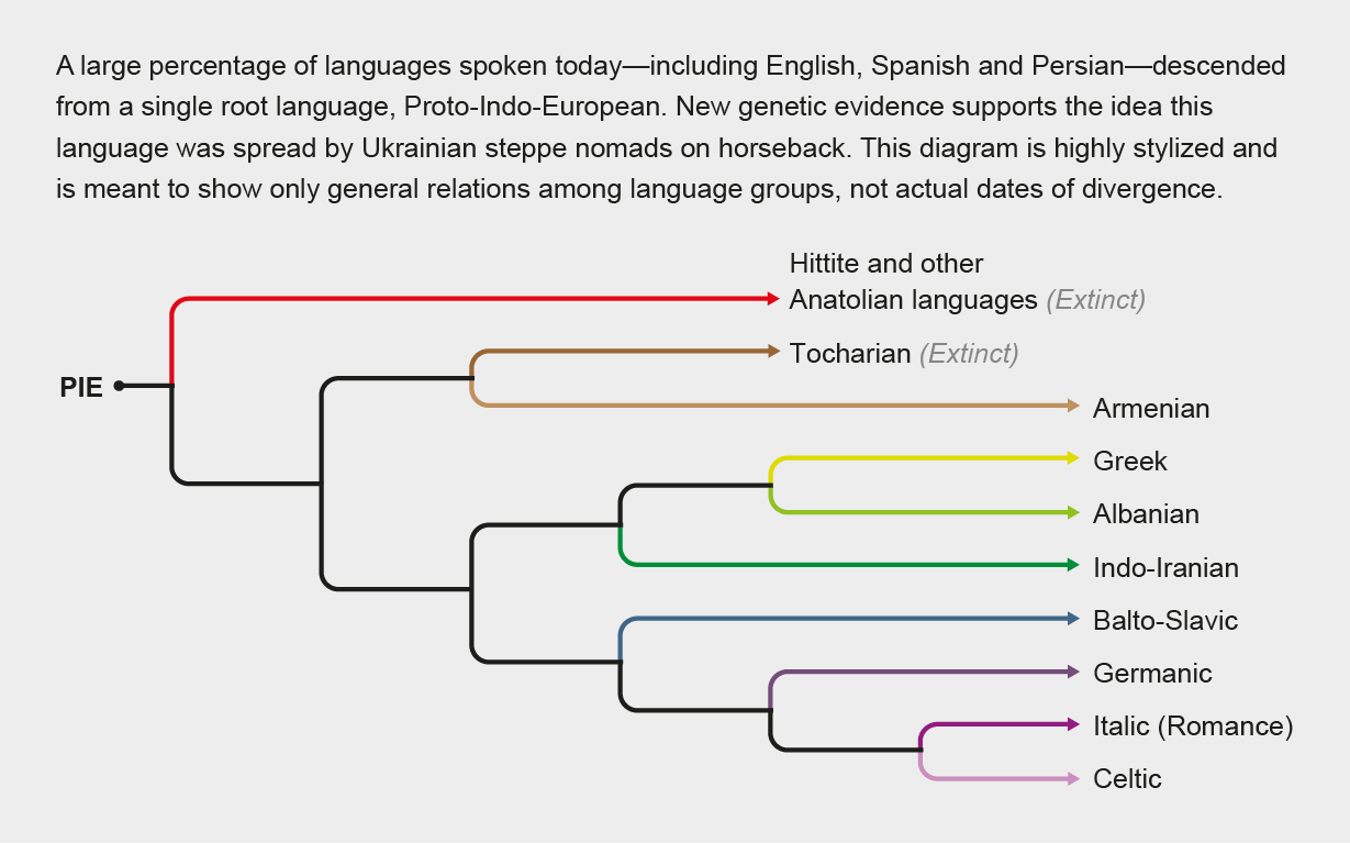
Credit: Tiffany Farrant-Gonzalez; Source: “Mapping the Origins and Expansion of the Indo-European Language Family,” by Remco Bouckaert et al., in Science, Vol. 337; August 24, 2012
Newer findings complicate the story, however. In a study published last June in the Journal of Human Genetics, researchers sequenced the mitochondrial DNA of 12 Yamnaya individuals, along with their immediate predecessors and descendants. The remains were found in burial mounds, or kurgans (from which the theory takes its name), in modern-day Ukraine. They had been buried in layers atop one another from the end of the Stone Age through the Bronze Age, between about 4500 and 1500 B.C.—the same time as the genetic replacement event in Europe. The earliest and midrange specimens' mitochondrial DNA (which is inherited from the mother) was almost entirely local. But the mitochondrial DNA of the most recent specimens included DNA from central Europe, including present-day Poland, Germany and Sweden. This discovery indicates that “there were pendulum migrations back and forth,” says lead author Alexey Nikitin, a professor of archaeology and genetics at Grand Valley State University. In other words, he adds, “it wasn't a one-way trip.”
These findings give the kurgan hypothesis “a lot more credit,” Nikitin says. But he contends that his new results also show the migration was on a smaller scale than previously speculated; the more recent specimens apparently only made it as far as central Europe before returning, even though the language eventually spread as far as the British Isles. Nikitin also believes the dissemination was not as violent as it is often made out to be. “A military campaign would explain the genetic replacement. But that's [unlikely to have been] the case,” he says.
David Anthony, an anthropologist at Hartwick College, who co-authored several of the earlier genetic studies but was not involved in the latest work, calls the new findings very convincing. “The domestication of the horse created a steppe bridge into India and Iran on the one side and Europe on the other side,” Anthony says. “When [the] Yamnaya people moved into eastern and western Europe, their genetic signature was very different from what was there before,” he explains. “That's what makes it paint such a clear picture [of how the root language spread] and why you can really see the migrations so easily on a map.”
Yet Anthony disagrees with the interpretation that this was a small and mostly peaceful affair. Without written words, language transmission at the time would have depended largely on face-to-face contact, he says, suggesting the PIE speakers swept well across Europe and Asia. He believes linguistic and archaeological evidence, including weapons found in graves, suggests the language's progenitors had a warrior culture. Nikitin argues the ax-heads were purely “decorative,” however.
Both researchers caution against reading too much into genetic evidence alone. Many other social and cultural forces were at play. “Language shifts generally flow in the direction of groups that have higher economic status, more political power and higher prestige,” Anthony says. “And in the most brutal situations, it will flow in the direction of people who survived.”