
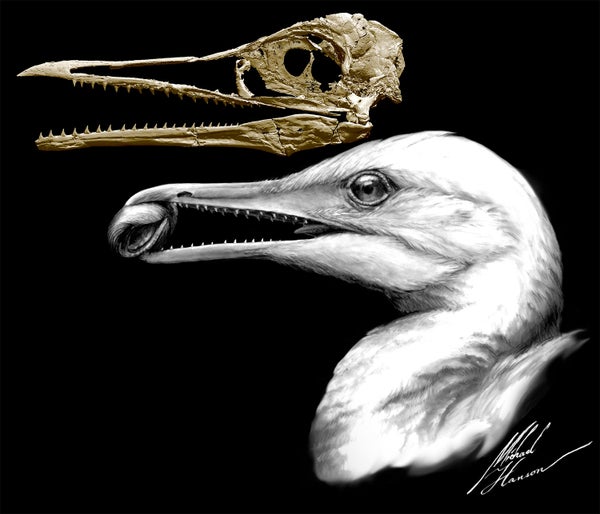
For more than a century the only known skulls of the ancient bird Ichthyornis were either fragmentary, smashed flat or both. Now, high-tech analyses of four fossilized three-dimensional skulls provide tantalizing hints about what the beak of this iconic creature might have looked like as well as clues about the evolution of early birds.
Ichthyornis, which was first described in the 1870s, was a ternlike bird that lived during the late stages of the Cretaceous period and apparently died out around the same time as the dinosaurs and many other species, approximately 66 million years ago. Most of its fossils have been found in sedimentary rocks that accumulated in a broad seaway that once stretched from the Gulf of Mexico to the Arctic Ocean, says Bhart-Anjan Bhullar, a vertebrate paleontologist at Yale University and co-author of the study. Although fossils of the species’s body are often well preserved, unbroken remains of its delicate skull remained elusive until one of Bhullar’s teammates literally stumbled across a specimen while prospecting for fossils in Kansas in 2014.
Recently Bhullar’s team used high-resolution, CT-like scans of that specimen and three other less-complete (but still largely three-dimensional) skulls to get the first good look at what Ichthyornis’s head looked like and how its bones were arranged. The new findings, reported in this week’s Nature, “demonstrate the power of technology to discover new things about old fossils,” says Mark Norell, a vertebrate paleontologist at the American Museum of Natural History who was not involved with the study.
On supporting science journalism
If you're enjoying this article, consider supporting our award-winning journalism by subscribing. By purchasing a subscription you are helping to ensure the future of impactful stories about the discoveries and ideas shaping our world today.
The team’s digital models of the skulls revealed an odd blend of avian and dinosaurian features, Bhullar says. Like modern birds, Ichthyornis’s upper jaw was made of several bones and was somewhat bendable, allowing the tip of the snout to flex upward and broaden the bird’s gape when grabbing prey. Its brain, too, was more like that of modern birds than that of dinosaurs. But chambers on each side of the skull suggest Ichthyornis had large jaw muscles more similar to those of its dinosaurian ancestors.
That mixture of features challenges a prevailing evolutionary model that an expansion of brain size in birds drove a reduction in the size of their jaw-closing muscles, says Xu Xing of the Institute of Vertebrate Paleontology and Paleoanthropology in Beijing, who also was not part of the research. The team’s findings “highlight the importance of fossils in testing evolutionary hypotheses,” he notes.
The finding also offers insights into what Ichthyornis’s beak might have looked like. The team’s scans revealed roughened patches of bone particularly rich in blood vessels—the same sort of features that underlie the keratinous sheath that makes up the beaks of modern-day birds—near the tips of Ichthyornis’s upper and lower jaws, Bhullar says. Much of the remainder of the bird’s jaws sported teeth that were only a couple of millimeters long.
Although Ichthyornis’s pincerlike beak was limited to the tip of its snout, it was likely used, like modern-day bird beaks, for precision tasks such as preening feathers and holding small objects. It became, Bhullar notes, a surrogate hand—which the bird needed because its forelimbs had evolved into wings.