
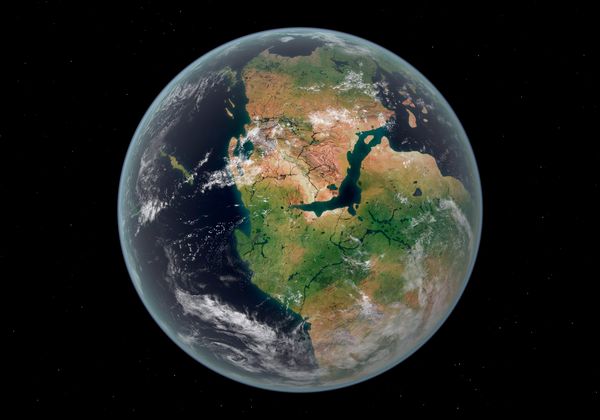
More than 180 million years after the supercontinent Gondwana’s breakup, scientists are still learning the true reach of this prehistoric landmass that once stretched across the globe.
By analyzing more than 25,000 volcanic rocks, a new study finds that Gondwana likely accounted for around 80 percent of total global land area around 500 million years ago. The analysis identifies pieces of Earth’s crust deep beneath Asia, Europe and North America that were once part of the supercontinent. That’s far larger than scientists had thought: older studies estimated Gondwana’s size as equivalent to around 64 percent of global land area.
This massive size means Gondwana’s formation and development over time could have been instrumental in the Cambrian explosion of life, the authors write—a period from about 540 to 530 million years ago when nearly all modern-day animals’ ancestors appeared on Earth for the first time.
On supporting science journalism
If you're enjoying this article, consider supporting our award-winning journalism by subscribing. By purchasing a subscription you are helping to ensure the future of impactful stories about the discoveries and ideas shaping our world today.
To uncover the hidden landscapes, researchers analyzed the chemical composition of deeply buried rocks from different geochemistry databases and mapped Gondwana using the distribution of elements within the rocks.
The newly revealed geographical areas, combined with existing knowledge of the supercontinent, reveal that Gondwana could have had outsized effects on sea level, atmospheric gas and volcanic eruptions—together these factors would have influenced early life on Earth, the researchers write. The findings were published today in Science Advances.
It’s possible that still-undiscovered parts of the continent could have been submerged or recycled back into Earth’s crust, the authors write. That means that even this massive new scale could be an underestimate as scientists continue to piece together our planet’s early history.