
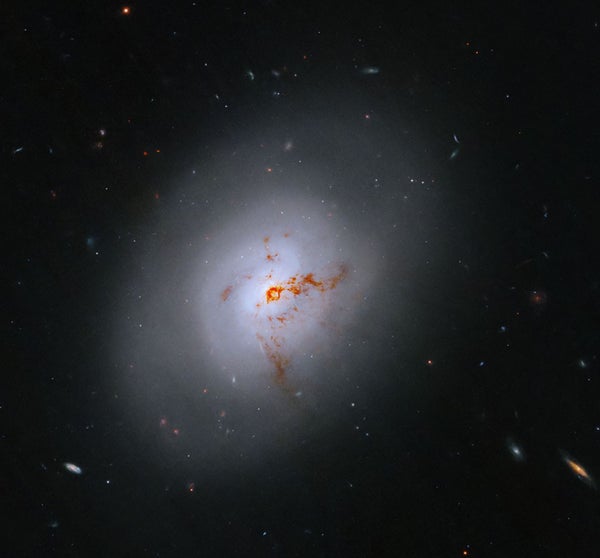
The universe teems with galaxies, but in our neighborhood of the universe, some are rarer than others. Most of the local galaxies are young, vibrant things that are bursting with freshly born stars or more sedate, elliptical galaxies that have minimal star formation. Just 1 percent are somewhere in between, and now NASA’s Hubble Space Telescope appears to have caught a rare glimpse of one such transitional galaxy.
Located 100 million light-years from Earth in the constellation Eridanus, the galaxy, called NGC 1266, is what’s known as a lenticular galaxy. In a statement, NASA explained that these galaxies are viewed by astronomers as an “evolutionary bridge” between spiral galaxies such as the Milky Way and elliptical galaxies, which are known for having a shape like a stretched-out circle. NGC 1266 has the lenslike, flattened disk shape and bright central bulb of a spiral galaxy. But it has no spiral arms and—like an elliptical galaxy—appears to have little to no ongoing star formation.
In the new Hubble image, the galaxy can be seen partially obscured by rusty-colored clumps of dust and gas. While NGC 1266 may not be generating new stars, that wasn’t the case in the not-too-distant past (relative to the age of the universe, at least). The stars in the galaxy appear to be relatively young, meaning NGC 1266 is a poststarburst galaxy. Just about one galaxy out of every 100 in the area near the Milky Way falls into this middle-aged category.
On supporting science journalism
If you're enjoying this article, consider supporting our award-winning journalism by subscribing. By purchasing a subscription you are helping to ensure the future of impactful stories about the discoveries and ideas shaping our world today.
Astronomers believe that, some 500 million years ago, NGC 1266 merged with a smaller galaxy, leading to a burst in star formation—but the collision also increased the mass in the central bulge. While the extra gas could have led to more new stars, it appears that this gas was instead sucked into the galaxy’s central supermassive black hole. As the black hole became more active, it generated powerful gusts of gas along its axis of rotation, which would have further disrupted the star-making process. Past observations by Hubble and other observatories have picked up outflows of gas from NGC 1266, lending further support to this theory of why so few new stars are being born there.