
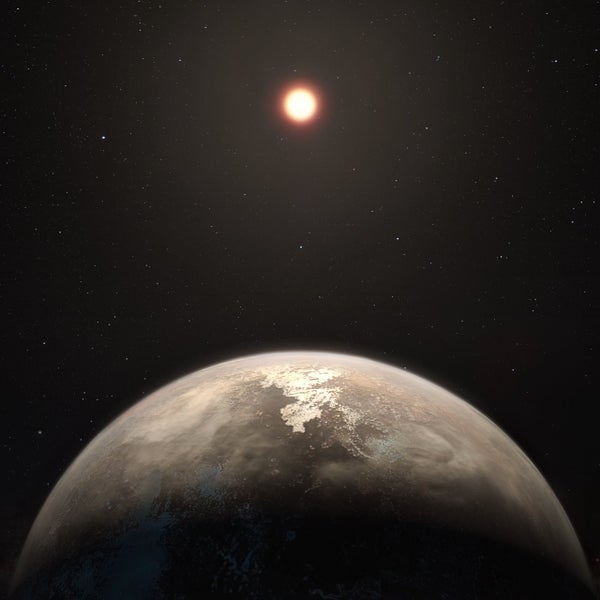
A newfound exoplanet may be one of the best bets to host alien life ever discovered—and it's right in Earth's backyard, cosmically speaking.
Astronomers have spotted a roughly Earth-mass world circling the small, dim star Ross 128, which lies just 11 light-years from the sun. The planet, known as Ross 128b, may have surface temperatures amenable to life as we know it, the researchers announced in a new study that will appear in the journal Astronomy & Astrophysics.
Ross 128b is 2.6 times more distant from Earth than Proxima b, the potentially habitable planet found in the nearest solar system to the sun. But Proxima b's parent star, Proxima Centauri, blasts out a lot of powerful flares, potentially bathing that planet in enough radiation to stunt the emergence and evolution of life, scientists have said. [10 Exoplanets That Could Host Alien Life]
On supporting science journalism
If you're enjoying this article, consider supporting our award-winning journalism by subscribing. By purchasing a subscription you are helping to ensure the future of impactful stories about the discoveries and ideas shaping our world today.
Radiation is likely much less of an issue for Ross 128b, because its parent star is not an active flarer, said discovery team leader Xavier Bonfils, of the Institute of Planetology and Astrophysics of Grenoble and the University of Grenoble Alpes in France.
"This is the closest Earth-mass planet potentially in the habitable zone that orbits a quiet star," Bonfils told Space.com via email, referring to the range of orbital distances where liquid water could exist on a world's surface.
A possibly habitable world
Bonfils and his colleagues found Ross 128b using the High Accuracy Radial velocity Planet Searcher (HARPS), an instrument at the European Southern Observatory's La Silla Observatory in Chile.
As its name suggests, HARPS employs the "radial velocity" method, noticing the wobbles in a star's movement induced by the gravitational tugs of orbiting planets. (NASA's prolific Kepler space telescope, by contrast, uses the "transit" technique, spotting tiny brightness dips caused when a planet crosses its host star's face from the spacecraft's perspective.)
The HARPS observations allowed Bonfils and his team to determine that Ross 128b has a minimum mass 1.35 times that of Earth, and that the planet orbits its host star once every 9.9 Earth days.
Such a tight orbit would render Ross 128b uninhabitable in our own solar system. But Ross 128 is much cooler than the sun, so the newfound world is likely temperate, the researchers said. Determining whether the planet is actually capable of supporting life as we know it, however, would require a better understanding of its atmosphere, Bonfils said.
"Ross 128b receives 1.38 times [more] irradiation than Earth from our sun," he said. "Some models made by theorists say that a wet Earth-size planet with such irradiation would form high-altitude clouds. Those clouds would reflect back to space a large fraction of the incident light, hence preventing too much greenhouse heating. With those clouds, the surface would remain cool enough to allow liquid water at the surface. Not all models agree, though, and others predict this new planet is rather like Venus.
Looking for signs of life?
Though both Ross 128 and Proxima Centauri are red dwarfs — the most common type of star in the Milky Way galaxy—they are very different objects.
"Proxima Centauri is particularly active, with frequent, powerful flares that may sterilize (if not strip out) its atmosphere," Bonfils said. "Ross 128 is one of the quietest stars of our sample and, although it is a little further away from us (2.6x), it makes for an excellent alternative target."
And the star may indeed be targeted in the not-too-distant-future—by giant ground-based instruments such as the European Extremely Large Telescope, the Giant Magellan Telescope and the Thirty Meter Telescope, all of which are scheduled to be up and running by the mid-2020s.
Such megascopes should be able to resolve Ross 128b and even search its atmosphere for oxygen, methane and other possible signs of life, Bonfils said. (NASA's $8.9 billion James Webb Space Telescope, which is scheduled to launch in early 2019, probably won't be able to perform such a biosignature search, the researchers said in their discovery paper. If Ross 128b transited its host star from Webb's perspective, it would likely be a different story, they added.)
Earlier this year, by the way, radio astronomers detected a strange signal that seemed to be emanating from Ross 128. But further investigation revealed that the signal most likely came from an Earth-orbiting satellite, not an alien civilization.
EDITOR'S RECOMMENDATIONS
Copyright 2017 SPACE.com, a Purch company. All rights reserved. This material may not be published, broadcast, rewritten or redistributed.