
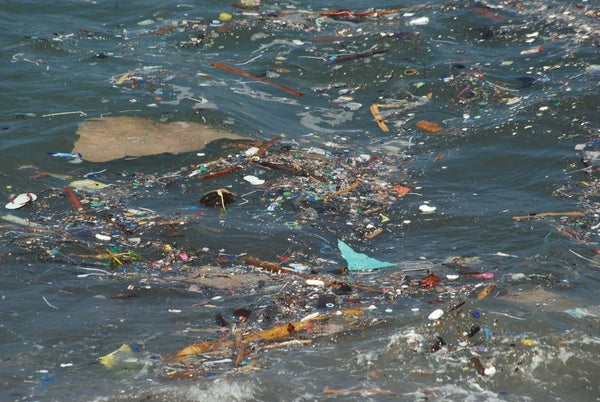
Despite their name, microplastics are a gigantic player in pollution worldwide. These fibers, beads and fragments (defined as being less than five millimeters in size) have infiltrated nearly every environment, especially oceans. To track the problem, researchers are now homing in on these seaborne flecks from more than 300 miles away—in space.
Recent research in Scientific Reports details how microplastics appear to flow alongside floating patches of oily and soapy substances called surfactants, which create distinct footprints in ocean currents. Those footprints are detectable by NASA's Cyclone Global Navigation Satellite System (CYGNSS), a network of eight hurricane-monitoring satellites, and tracking them could help map microplastics' spread, aiding cleanup and regulation efforts.
“In general, there are insufficient data about microplastics concentration in the ocean,” says University of Michigan marine engineer and study coauthor Yulin Pan. Computer models and samples from trawling nets are helpful but incomplete, Pan adds: “That is one of the reasons that we really want a remote sensing technique, to have a general understanding.”
On supporting science journalism
If you're enjoying this article, consider supporting our award-winning journalism by subscribing. By purchasing a subscription you are helping to ensure the future of impactful stories about the discoveries and ideas shaping our world today.
The CYGNSS satellite radar measures the ocean surface's roughness, caused by wind-generated waves. In 2021 CYGNSS researchers noticed the radar picking up peculiar areas of smoothness with fewer and smaller waves. The scientists realized these anomalies lined up with the notorious Great Pacific Garbage Patch—and seemed to correlate with levels of microplastics in the water. These initial findings were later used to track microplastics' flow in other hotspots.
But researchers still didn't know the mechanism behind the smoothness or whether it might be linked to factors aside from microplastics such as marine life, other debris, or chemical interactions. Isolating microplastics' influence is “hard if you don't have good training data, where you have microplastics in one part of the ocean and then you can remove them all and test it again,” says University of Washington mechanical engineer Michelle DiBenedetto, who studies microplastics fluid dynamics and was not involved in the new research.
For their study, Pan and his CYGNSS colleagues did the next-best thing: they used a 750,000-gallon indoor wave tank to simulate real-world currents. They found that microplastics alone, at their reported ocean concentration, did not generate matching patches of smoothness. Instead the smoothing came when the researchers added surfactants. These chemicals—which influence wave activity by decreasing the water's surface tension—often accompany microplastics as a by-product of plastic production and breakdown and are carried on the same ocean currents. Because the satellites easily spot surfactants' smoothing effect, the substances can act as a tracer for microplastics' movements, the researchers say.
DiBenedetto says tracing surfactants is a tactic “worth pursuing,” but more information is needed on their relationship with microplastics in a field setting. This summer the CYGNSS team is coordinating with National Oceanic and Atmospheric Administration research vessels to compare satellite data with water samples from the Great Pacific Garbage Patch. This comparison should further solidify the correlation between surfactants and microplastics, Pan says.
Microplastics “can persist for a really long time,” DiBenedetto says. “If we want to invest in solutions, we want to know how plastic naturally moves around so that we can most optimize our resources and go after the places we can make the biggest difference.”