
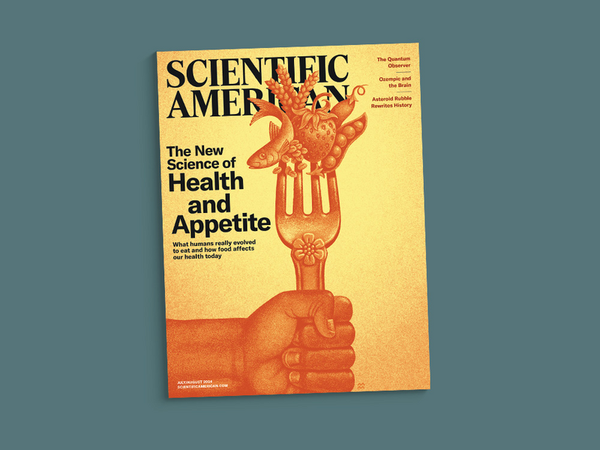
There’s never been a better time to eat. Those of us with the means and a decent grocery can buy fresh fruits and vegetables year-round. Dairy products are pasteurized and no longer teeming with dangerous microbes. The Dutch once waged war over nutmeg; now it’s on aisle six.
We have the luxury of choice but also the burden of trying to make sense of all the conflicting messages about food and nutrition. Some of the most vigorous diet-advice nonsense comes from people who say we should eat like our ancestors did. But our ancestors didn’t eat the way influencers claim. Scientific American’s senior evolution editor Kate Wong explains what we evolved to eat (and ate to evolve), at the beginning of our special report on health and appetite.
A new class of drugs that mimic the hormone GLP-1 are helping people lose weight in part by changing how they think about food. Scientific American associate health editor Lauren J. Young covers newfound connections between the gut and brain. Obesity is now classified as a disease, but not everyone with obesity has symptoms of poor health, such as high blood pressure or insulin resistance. New research explores the unusual phenomenon of people who are heavy and healthy, and author Christie Aschwanden breaks down changing conceptions of weight and fat. Our Graphic Science column spells out what vitamins and minerals we need and how they act in the body.
A quantum particle exists in a “superposition” of states until someone observes it, at which point the metaphorical cat in the box either is or isn’t dead. Author Anil Ananthaswamy wrestles with one of the mind-bending questions of quantum theory: Who or what is the observer? An artificial intelligence might help resolve a long-standing paradox.
If any tree could walk, it would be a mangrove—just look at those leggy roots and branches. The trees are migrating north with climate change in the U.S., and Florida writer Michael Adno keeps up with the scientists who are tracking their new range in skiffs and on foot.
Cracks present a hazard to modern life—bridges, airplanes, condominiums and our own teeth can fail catastrophically when they fracture. Mathematician Manil Suri delves into the latest computer engineering research on the origins and growth of structural cracks and ways to prevent them.
Studies of meditation are entering a third wave, focused on advanced or deep meditation. Medical researchers Matthew D. Sacchet and Judson A. Brewer describe how they’re studying these mental states in practitioners and what they can reveal about consciousness.
The OSIRIS-REx mission brought back bits of asteroid Bennu last year, and the first analyses of these samples show that Bennu was once part of a world that was wet, possibly tectonically active, and bathed in light from a star or stars that were destroyed before our own solar system existed. Isn’t that wonderful? Science writer Robin George Andrews shares more here.
On July 16 we’ll publish an online issue on “Fun and Games.” Stop by our website for puzzles, playable games and interactives, as well as feature stories about new baseball rules, poker strategies, the Monty Hall problem and game history. We can help you choose a game that’s right for you.
Recently we relaunched our podcast Science Quickly with a new host—writer and editor Rachel Feltman—and a new rhythm of news and deep dives. Please check it out.
Enjoy this supersize July/August issue and all our online offerings.