
To study the behavior of elusive animals, scientists routinely tag them with GPS location trackers. But such devices' battery capacity limits how long they operate, often bringing an early end to vital conservation work.
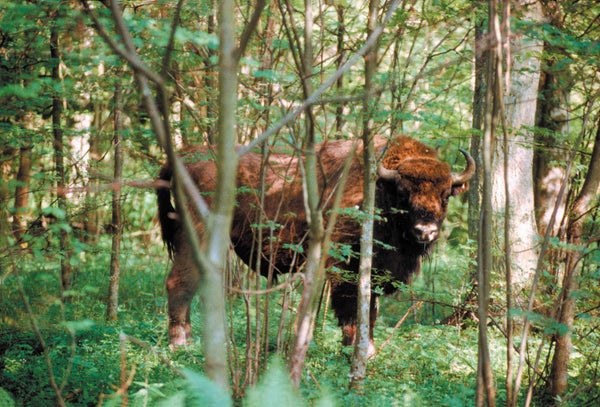
Solar-powered trackers break easily, making them a poor choice for devices strapped to larger mammals—and they don't work for nocturnal creatures. So biologist Rasmus Worsøe Havmøller of the University of Copenhagen and his colleagues turned to another abundant power source: kinetic energy generated by an animal's movements. Their kinetic tracker, which Havmøller's team recently tested on domestic dogs, a wild pony and a European bison, could theoretically survive for the entire life span of an active animal. It is also lighter and cheaper to make than its battery-powered counterparts.
The design “is ingenious and exciting,” says Mark Hebblewhite, a habitat ecologist at the University of Montana, who was not involved with the new work. The proof-of-concept kinetic tracker works by means of a magnetic pendulum that swings around a copper coil, generating electricity as the tagged animal moves. The dogs and bison in the study were active enough to create the energy to transmit one location ping per day for 14 days and 17 days, respectively. One of the wild pony's trackers lasted at least 146 days but didn't produce enough power for daily transmissions, the researchers reported in PLOS ONE.
On supporting science journalism
If you're enjoying this article, consider supporting our award-winning journalism by subscribing. By purchasing a subscription you are helping to ensure the future of impactful stories about the discoveries and ideas shaping our world today.
The limited power generated by the animals' movements means the technology isn't ready for prime time just yet, says ecologist Emily Studd of British Columbia's Thompson Rivers University, who wasn't involved in the study. When researchers want to keep close tabs on animals, they often need GPS fixes more than once a day. But Studd says that “with a bit more development, this could be a game changer for wildlife animal research and monitoring.“
Havmøller and his colleagues hope conservation workers can one day use this technology to track species such as tigers, leopards and wolves, which can easily destroy solar-powered trackers—and which hunt and travel at night.