

The newest, smallest pacemaker comes with no strings attached—literally. A research team at Rice University, the Texas Heart Institute and Baylor College of Medicine recently created a heartbeat regulator that gets its power via microwaves instead of wires. This greatly simplifies battery-replacement surgery and could reduce complications associated with conventional pacemakers.
Nearly 190,000 Americans received a pacemaker in 2009, the most recent year for which data were readily available. The devices have traditionally required a battery pack, embedded just below the collarbone, with leads that thread through the veins and into the heart. But “leads cause infection, and they're big, and they cause complications,” says head researcher Aydin Babakhani of Rice, who presented the product with his colleagues at a recent microwave science conference in Honolulu.
An earlier wire-free pacemaker won FDA approval in April 2016. It condensed a battery and circuit board into a pill-size implant attached to the heart's inner wall inside the right ventricle, the only chamber with enough space for the unit. When the battery dies, the entire unit must be surgically removed.
On supporting science journalism
If you're enjoying this article, consider supporting our award-winning journalism by subscribing. By purchasing a subscription you are helping to ensure the future of impactful stories about the discoveries and ideas shaping our world today.
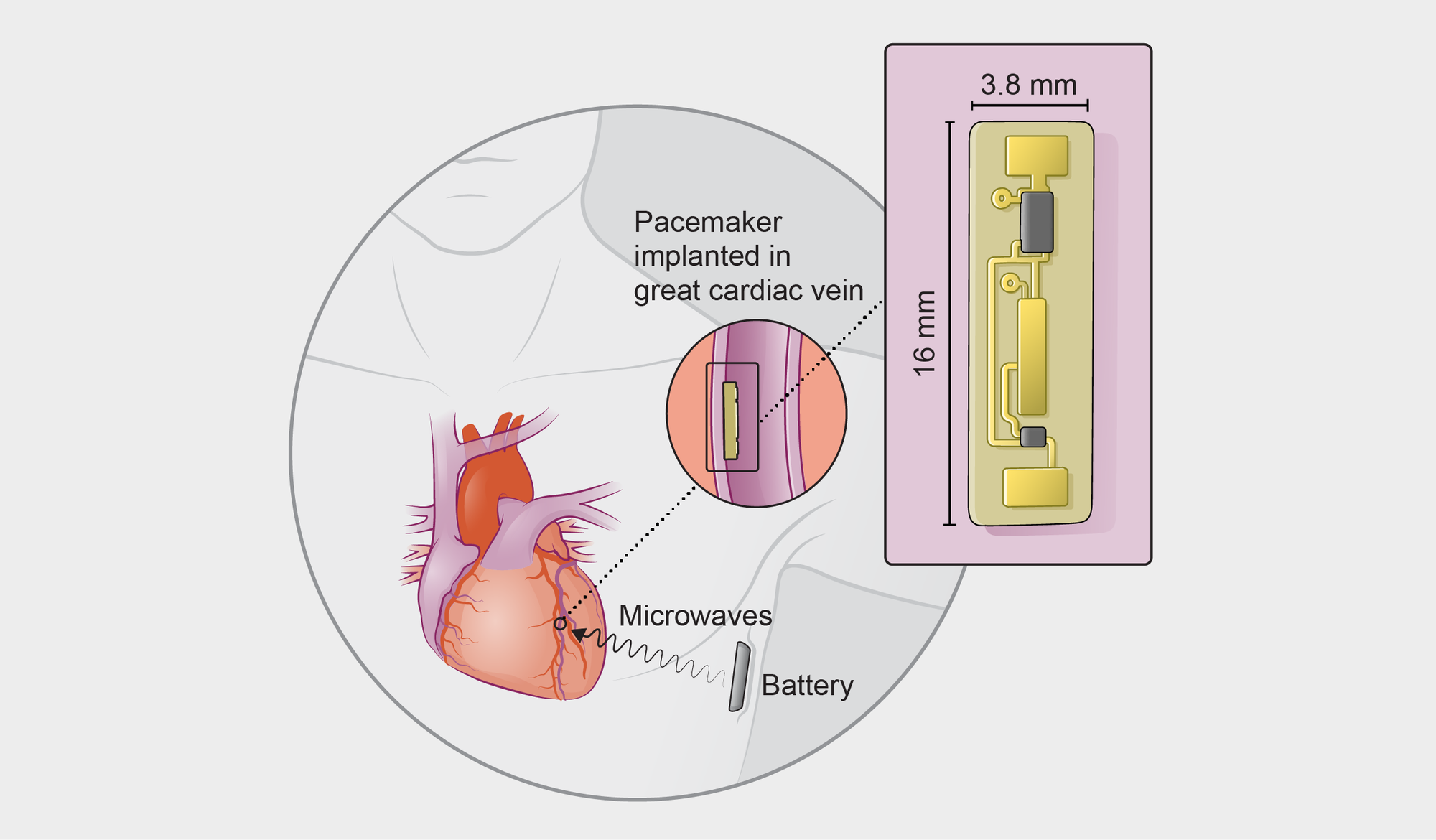
Credit: Tami Tolpa; Source: Mehdi Razavi Texas Heart Institute and Baylor College of Medicine
The Rice team's pacemaker combines the battery accessibility of the traditional device with the wireless feature of the 2016 version. A battery inserted below the armpit transmits power via microwaves to a capacitor implanted in the heart (graphic). The capacitor triggers the muscle contractions that make the organ pump blood. The device packs a big punch for its tiny size, Babakhani says. Multiple chips, each smaller than a dime, can be inserted throughout the heart wherever needed. The pacemaker is like “a conductor of a symphony,” says Mehdi Razavi of the Texas Heart Institute and Baylor, who helped to create the device.
Babakhani says his colleagues have successfully implanted their new pacemaker in five pigs, regulating the animals' heartbeats at a variety of paces with no immediate adverse effects. The animals were euthanized after a couple of hours, Razavi says, but this fall the team begins long-term animal testing. Even if the implant works well, installing it still requires an invasive procedure, notes James Chang, an echocardiographer at Beth Israel Deaconess Medical Center and Harvard University, who was not involved in the work. But he, for one, cannot wait to see rechargeable, leadless pacemakers such as Babakhani's in the operating room: “This is certainly the way of the future.”