
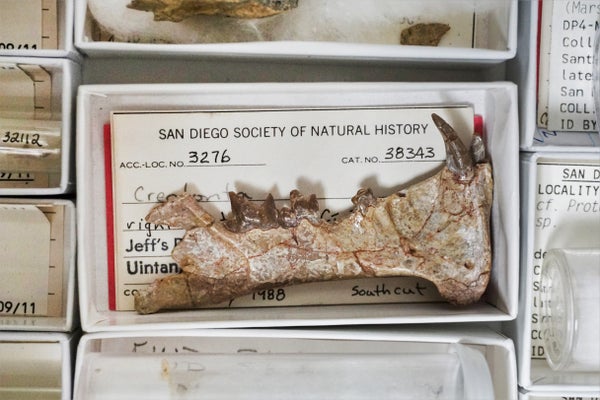
San Diego looked very different back in the Eocene epoch, from about 56 million to 34 million years ago. The area’s now arid climate was warmer and more humid, its lush subtropical forests teeming with primates and marsupials. Now a recently examined fossil adds another creature to the list: a new species of saber-toothed predator.
The fossil—the lower jaw of a catlike mammal—was found in 1988 at a construction site in Oceanside, Calif. Researchers who newly studied it using modern techniques found that it belonged to a previously unknown machaeroidine, or member of the rare subfamily Machaeroidinae, a group including five other now extinct carnivorous saber-toothed predators. The specimen is believed to be 42 million years old and is well preserved despite some pieces being broken off.
Named after a former president of the Society of Vertebrate Paleontology, Blaire Van Valkenburgh, the new species Diegoaelurus vanvalkenburghaeis estimated to have been about the size of a modern bobcat but with a longer body and shorter limbs. (Cats had not yet evolved when this animal lived, and the lineage that would lead to them was just evolving around the time Diegoaelurus was roaming the earth.) With its enlarged upper canines estimated to be two to three inches long, the creature likely would have preyed on small- to medium-sized mammals similar in size to itself, the researchers say in a study published on Tuesday in PeerJ.
On supporting science journalism
If you're enjoying this article, consider supporting our award-winning journalism by subscribing. By purchasing a subscription you are helping to ensure the future of impactful stories about the discoveries and ideas shaping our world today.
.jpg?w=2000)
Artist’s rendering of Diegoaelurus vanvalkenburghae, which lived around 42 million years ago. Credit: San Diego Natural History Museum
Study co-author Ashley Poust, a paleontologist at the San Diego Natural History Museum, notes that the Diegoaelurus fossil was similar to remains of its fellow machaeroidines. But the jaw stood out because of the shape and size of the teeth, the spacing between them and the shape of the flange (the part of the chin that stuck down to protect the animal’s canine teeth).
Poust says Diegoaelurus also seems to be one of the first mammals to have figured out how to live as a somewhat successful hypercarnivore—an animal whose diet is more than 70 percent meat. Modern examples of such animals include house cats, lions and polar bears. But even though its specialized teeth made Diegoaelurus an excellent meat eater, they also left it and other machaeroidines vulnerable to extinction: the same tooth adaptation made it difficult to eat anything else.
An abundance of prey prompted Diegoaelurus’sancestors to evolve teeth that could process meat very efficiently, explains study co-author Shawn Zack, an anatomist at the University of Arizona College of Medicine–Phoenix. And as these ancestors became more specialized in meat eating, their teeth eventually developed larger cutting blades and smaller crushing and grinding surfaces—gradually losing the ability to break down other foods. “In Diegoaelurus, there’s barely anything left to the molars except the cutting blades, a lot like a living cat,” Zack says.
The new study—which involves the youngest known machaeroidine—expands what is understood about members of the group and their evolution. For example, the animal’s existence on the California coast overlapped with another genus (Apataelurus) from the same subfamily that lived in Utah’s Uinta Basin. “It shows that they [machaeroidines]were more diverse than we had previously known,” Zack says. “It was always kind of possible that maybe this was just one type of animal evolving over time and sort of evolving from one species to another. This is the first time we have pretty clear evidence that there were at least two different machaeroidines, and fairly different ones, alive at the same time.”
Jack Tseng, a University of California, Berkeley, paleontologist, who was not involved in the new study, says this discovery suggests that early saber-toothed mammals, even small-bodied ones, could become quite specialized in their dental and skeletal features. “This new evidence helps to flesh out the saber-toothed way of life as represented by an even more diverse range of sizes and shapes,” he says.
Additionally, the study proposes that the Diegoaelurus may have coexisted with nimravids, members of another saber-toothed family called Nimravidae, and that potential competition with early nimravids could have played a factor in machaeroidine extinction. “If they are closer to overlapping,” Poust says, “maybe actually they did meet and compete.”
Still, there is much left to discover about machaeroidines. Poust, Zack and their co-author Hugh Wagner, also at the San Diego Natural History Museum, are aiming to answer more questions about machaeroidines’ evolution and ecology and the actual cause of their extinction. Saber-toothed animals “are weird. They’re mysterious,” Zack says. “We can use all the tools we have to try to figure out how they were living. But because there really isn’t any true saber-tooth around today, we’re never going to know exactly what they were like. So being able to describe something like this really does help to emphasize just how much new stuff we are discovering and also how much there is still to discover."