
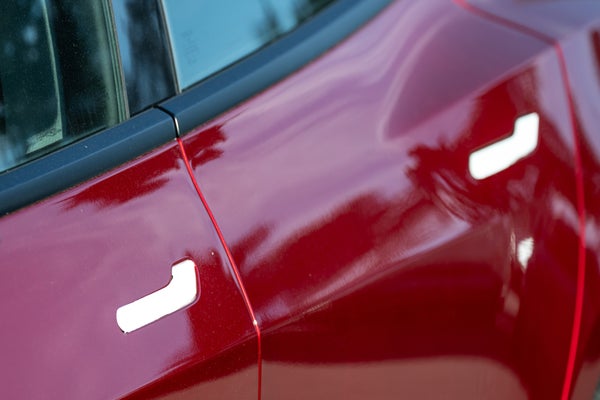
The National Highway Traffic Safety Administration (NHTSA) is considering new car-door safety rules after reports that people were unable to escape burning Teslas. But any changes could be years away from taking effect.
On July 24 NHTSA denied a citizen’s request, filed last November, that the agency initiate a safety defect investigation into 2022 Tesla Model 3s. The request alleged that the cars’ manual emergency door releases, intended to work when their electronic controls fail, were not readily accessible or identifiable.
The petitioner said their Model 3’s electronic door-opening controls failed after the car had a head-on collision and caught fire. They were also unable to locate the manual release and were forced to climb through the back seat and exit through a rear passenger window.
On supporting science journalism
If you're enjoying this article, consider supporting our award-winning journalism by subscribing. By purchasing a subscription you are helping to ensure the future of impactful stories about the discoveries and ideas shaping our world today.

Tesla occupants normally press an electronic button to open the front door from inside. If the vehicle loses power, a separate mechanical lever beside the window controls provides a backup—but its design and location may be unfamiliar to passengers.
Andres Valenzuela/Toronto Star via Getty Images
A December 2025 Bloomberg investigation identified at least 15 people who died in crashes in which Tesla doors could not open.
In its decision, NHTSA said the issue would be better addressed through a broader rulemaking process than through a defect investigation. Current federal rules govern door locks, latches and hinges but do not specify where an emergency mechanical release must be located or how clearly it must be labeled. The agency is now considering a new rule mandating a “robust and obvious door egress system” in all cars.
“NHTSA does not believe that the issues presented by the Petitioner indicate the likelihood of a safety related defect that would warrant a defect investigation, and the issue is best addressed through the rulemaking process,” the agency wrote.
That process began with a separate petition from a California resident who called on the agency to require all cars to have fully operable manual releases that are “intuitively obvious” to occupants and work even when the car’s electrical system has completely failed.
Although NHTSA has granted the rulemaking petition, that is “not a decision by NHTSA to issue a new safety standard, but commences the process of gathering input to make an informed decision,” an NHTSA spokesperson said in a statement. The agency said it will gather additional information and solicit public comments before deciding whether a new standard is warranted.
The petition called for any new rule to apply to all cars sold on or after January 1, 2030, but it’s not clear when NHTSA could finish its rulemaking process. Hitting that date would be unlikely, says Peter Kurdock, general counsel for Advocates for Highway & Auto Safety.
“It is not currently part of the 2026 regulatory agenda, so we have no target date or description of exactly what this rulemaking would entail,” he says, noting that other vehicle-safety rulemakings have taken up to 15 years. NHTSA could move faster on door safety, but “this is really the first step in what very likely will be a very long journey,” he says.
Congress could force the process to move faster. In May the House Committee on Energy and Commerce advanced a bill that would require NHTSA to issue a rule mandating readily accessible mechanical interior door releases in cars equipped with electronic latches. The legislation has not passed either chamber of Congress.
A Tesla spokesperson did not immediately respond to requests for comment from Scientific American.