
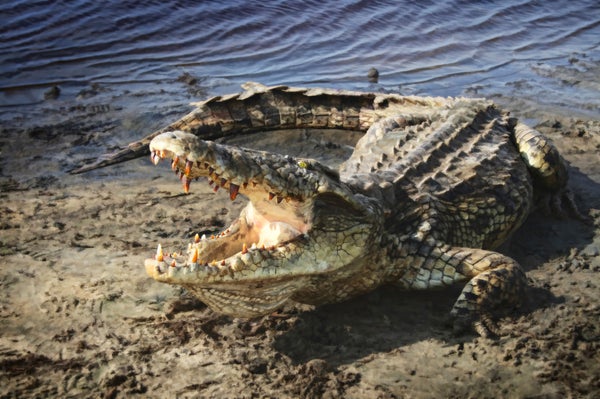
Florida's native alligators and crocodiles could be facing some new competition—from a bigger and meaner member of their own crocodilian family. Nile crocodiles—American crocodiles' larger, more aggressive cousins from the African continent—have been identified in the wild in southern Florida for the first time, according to a new study.
Between 2009 and 2012, scientists responded to reports from Floridians of "unusual looking" crocodiles, the study authors said. The scientists caught three young crocodiles—one of which was captured on the porch of a Miami home—and, through genetic analysis of tissue samples, confirmed that they were invasive Nile crocodiles, connecting them to crocodile populations in South Africa.
A female crocodile captured in 2012 was released and later recaptured in 2014, providing the scientists with proof that the Nile crocodile species could survive and thrive in the Everglades for nearly two years. In fact, they found that the crocodile grew about 28 percent faster during that period than juvenile Nile crocodiles typically grow in parts of their native African ranges. [Alligators vs. Crocodiles: Photos Reveal Who's Who]
On supporting science journalism
If you're enjoying this article, consider supporting our award-winning journalism by subscribing. By purchasing a subscription you are helping to ensure the future of impactful stories about the discoveries and ideas shaping our world today.
Nile crocodiles (Crocodylus niloticus) measure about 16 feet (5 meters) long, on average, but can grow to be 20 feet (6 m) long, the scientists wrote in the study. A full-grown Nile crocodile is an opportunistic predator that eats whatever big animals it can catch, such as zebra, buffalo, "and any other animal it can overpower, swallow whole, or rip apart and ingest"—even people, according to a nonindigenous aquatic species fact sheet published by the U.S. Geological Survey (USGS).
The USGS added that Nile crocodiles preying on humans in Africa have been "well documented" since the 1950s, and the scientists reported in their study that Nile crocodiles were responsible for 480 attacks on people across their range in Africa between 2010 and 2014, resulting in 123 deaths.
DNA taken from the captured crocs did not match samples from Nile crocodiles kept in Florida zoos. However, they were genetically identical to each other, hinting that they originated from the same source—likely, they were escapees originally brought to Florida for the exotic pet trade, the scientists suggested.
Florida's native crocodilians—the American crocodile (Crocodylus acutus) and the American alligator (Alligator mississippiensis) are somewhat smaller than the Nile crocodile and do not typically prey on people. American alligator males reach 10 to 15 feet (3 to 5 m) in length on average, and adult females can grow to be 10 feet long, according to the Florida Fish and Wildlife Conservation Commission (FWC).
Male American crocodiles can grow to be about 15 feet (5 m) long, while females typically range between 8 and 13 feet (2 to 4 m) in length, the FWC described in a fact sheet.
The Nile crocodile may be the biggest invader to take up residence in the Sunshine State, but it has plenty of company. Currently, about 500 nonnative fish and wildlife species call Florida home, according to the FWC.
The researchers found no evidence of established populations of Nile crocodiles lurking in Florida waters. But don't breathe a sigh of relief just yet, said study co-author Kenneth Krysko, the herpetology collections manager at the Florida Museum of Natural History.
Between Florida's exotic pet trade and the demand for Nile crocodiles in animal parks, there has been a steady flow of African crocs into the region, the researchers noted. If any of these animals were to escape, they would quickly find that the local climate and abundant food supply would help them do what they do best: hunt and grow.
"The odds that the few of us who study Florida reptiles have found all of the Nile crocs out there is probably unlikely," Krysko said in a statement.
The findings were published online April 30 in the journal Herpetological Conservation and Biology.
Copyright 2016 LiveScience, a Purch company. All rights reserved. This material may not be published, broadcast, rewritten or redistributed.