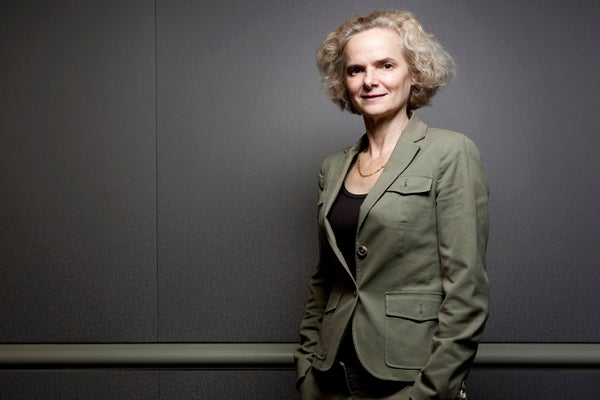
Nora D. Volkow is a psychiatrist and neuroscientist who has led the National Institute on Drug Abuse at the National Institutes of Health since 2003. Her research pioneered brain-imaging studies of addiction, helping establish substance use disorder as a chronic brain disease and shaping scientific understanding of its biological basis.
[This interview was edited for length and clarity.]
How would you describe the current state of American science?
On supporting science journalism
If you're enjoying this article, consider supporting our award-winning journalism by subscribing. By purchasing a subscription you are helping to ensure the future of impactful stories about the discoveries and ideas shaping our world today.
From the perspective of discovery and opportunity, it’s an incredibly exciting time. And it’s not just in the U.S. but science in general—the opportunity that we have [from] large data repositories that are harmonized with one another, alongside advances in computation and modeling, including artificial intelligence, that allow you to explore things in ways that we were never able to do before. I’m very, very excited. The tools that we have for discovery have never been better.
From the perspective of the NIH and the academic centers, the ability to streamline funds and research has generated a certain level of uncertainty. But I am very confident, and I feel that we are stabilizing things. We have a director at the NIH that has been able to lead the charge and identify what areas need to be prioritized to ensure that the funds that Congress gives us are deployed for academic institutions to do the science. Certainly we’ve been having challenges because of all of the changes that have occurred. But I feel that this is being stabilized, and I’m optimistic that we’ll see further advances.
What needs to change in American science?
We need to consolidate the support of scientists. When things get rocky, when it becomes harder to get resources, if our funds decrease, then the competition is much more fierce, and young scientists are likely the ones that fall in the cracks. So this is an area of major concern. How do we secure and ensure that we don’t lose a generation of scientists? What I’m seeing is some of these young scientists are leaving the U.S., which is really terrible because it is ultimately the next generation that builds us. So when you’re asking me what we should do, we should continue to fight to ensure that we can strengthen the ability of young researchers to actually stay in science and to stay in the U.S.
What gives you optimism right now?
In the past, we were constrained by the data that we had in front of us, which tended to just target one variable at a time and were also limited by the size of our sample. With the databases that we currently have and these new tools and technologies that have high throughput, there’s an enormous amount of innovation.
What’s your best advice for an early-career scientist?
My advice is: don’t get discouraged. There are always periods that are more or less challenging and where funding is more readily available than others. But science is such an extraordinary discipline, and the way that we do science is changing.
For example, one the projects that we’ve launched that we’re very proud of and that exemplifies how we’re changing is the [Adolescent Brain Cognitive Development Study], which is a prospective study of [about] 12,000 children. We’re monitoring their behaviors, physical activity, what they are eating, linked with databases of socioeconomic factors. And those data are deposited for anyone to be able to take advantage of. In the past, you couldn’t be involved as a researcher on brain imaging unless you were in an institution that had those capabilities. Now, by depositing these large datasets with very detailed brain imaging measurements, you can have more people jump in and take advantage of those resources. If you’re a young scientist, maybe you can start your line of research without having a high amount of funding. And that will make things much, much easier for everyone. You don’t necessarily just have to have your own laboratory and to continue.
How has your field changed in the past few years?
Our understanding has been expanded enormously with the BRAIN [Brain Research through Advancing Innovative Neurotechnologies] Initiative because it has given us extraordinary tools. For example, with tools at the molecular level, you can monitor the biochemical processes that are triggered by drugs. And with all of the advances in genetics and epigenetic modifications, we can characterize, at a great level, what these drugs are doing and how diverse those effects are.