
Something very strange appears to be happening deep, deep underneath the U.S. Midwest and the Ohio Valley.
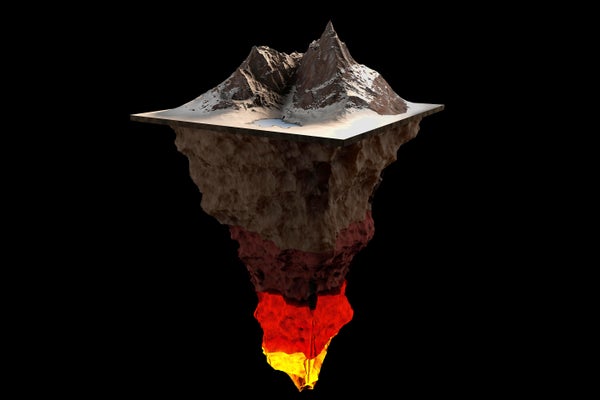
North America’s geological core has persisted for more than a billion years; it’s what scientists call a craton, a massive block of continental rock that withstands the natural recycling system of plate tectonics. Typically scientists think of cratons as unchanging, nigh eternal. But research published in Nature Geoscience suggests that a long-lost geological plate may be siphoning molten rock from the underside of the North American craton and eroding it from below, right under our feet.
Such a scenario would not be unprecedented—scientists have evidence that the North China craton thinned dramatically millions of years ago—but it would certainly be surprising and intriguing to study in real time. “Cratons are the oldest cores of continents, so they have been sitting near Earth’s surface for billions of years,” says Claire Currie, a geophysicist at the University of Alberta, who was not involved in the new research. “They’ve persisted through time, so this is quite unusual.”
On supporting science journalism
If you're enjoying this article, consider supporting our award-winning journalism by subscribing. By purchasing a subscription you are helping to ensure the future of impactful stories about the discoveries and ideas shaping our world today.
The scientists behind the recent research had no intention of finding an eroding craton, according to study lead author Junlin Hua, a geophysicist at the University of Science and Technology of China. The team merely wanted to apply a new, more precise analysis technique to the data gathered by North America’s rich network of more than 6,000 seismometers, in the hope of seeing the continent in more detail than ever before.
The work relied on the seismometer network’s observations of more than 200 earthquakes, each of which produced multiple types of seismic waves. These waves are affected in specific ways by changes in the material they pass through—for example, there are distinctive effects when that material is particularly cold or warm or is strong or weak. By analyzing the waves, scientists can reverse engineer a map of Earth’s innards, Hua says. And the researchers sought to conduct this work in a way that would account for every wiggle in the trove of seismic data, a laborious process.

A map produced by the authors of a new study in Nature Geoscience shows the relative seismic velocity of material that is 200 kilometers below Earth’s surface and located around the base of the North American craton. Cratons are characterized by high seismic velocity. On this map, blue represents rock through which seismic waves travel faster; red represents rock through which seismic waves travel more slowly. The black dashed line outlines the borders of the North American craton.
“Seismic Full-Waveform Tomography of Active Cratonic Thinning beneath North America Consistent with Slab-Induced Dripping,” by Junlin Hua et al., Nature Geoscience, Vol. 18. Published online March 28, 2025.
It was months into the analysis when Hua started to recognize that the investigation was turning up something surprising. The craton itself looked normal enough: a slab of dense rock, about 200 kilometers thick, through which seismic waves traveled relatively fast—what scientists refer to as high-seismic-velocity material—that abruptly transitioned to material with lower seismic velocity as the craton gave way to younger rock.
But below part of the craton, underneath much of the Midwest and the Ohio Valley, something strange was happening. Here a patchy pattern of molten material with that same high seismic velocity sagged to a depth of nearly 600 kilometers, almost to the lower mantle. Those measurements, Hua says, suggest that in this area North America’s craton is dripping downward into the mantle in a way he and his colleagues didn’t expect and couldn’t quite explain.
What got them unstuck was considering a relic of geological history that lies hidden under North America: remains of the Farallon plate, an oceanic plate that stretched between the Pacific and North American plates some 100 million years ago, when the dinosaurs were at their peak. Most of the Farallon plate was eventually shoved under North America. Its remnants linger in the lower mantle, some 800 kilometers below Earth’s surface, and indeed showed up in the cross sections of seismic velocities that Hua and his colleagues made.

ELabArts; Source: “Seismic Full-Waveform Tomography of Active Cratonic Thinning beneath North America Consistent with Slab-Induced Dripping,” by Junlin Hua et al., in Nature Geoscience, Vol. 18; April 2025 (reference)
When the scientists used computer modeling to test theories of what could pull cratonic material downward, the Farallon slab was key: drips formed only when the slab was incorporated into the model. Hua calls the slab “a big sinker” that pulls material off the craton and down into Earth.
Right now, Currie says, this is just a hypothesis—but one that she calls “intriguing.” Currie would like to see other signals of the cratonic drip—for example, is the surface of Earth being pulled down at all over this region? She would also like to see stronger explanations for how the craton gets drawn down into material denser than it is; it ought to float above such material.
Still, the research is a surprising glimpse of activity in an environment that scientists have long considered unchanging, Hua says. “The continent is not something static,” he says. “It has a dynamic component.”