
CLIMATEWIRE | U.S. scientists plan this month to launch a multiyear study of the stratosphere to help world leaders better understand whether it’s possible to use solar geoengineering to counter global warming.
And they're going back in time to do it.
The concept itself may sound futuristic — as one method of solar geoengineering calls for artificially changing Earth’s atmosphere to reflect more sunlight back into space.
On supporting science journalism
If you're enjoying this article, consider supporting our award-winning journalism by subscribing. By purchasing a subscription you are helping to ensure the future of impactful stories about the discoveries and ideas shaping our world today.
But the new NOAA mission will use retro equipment.
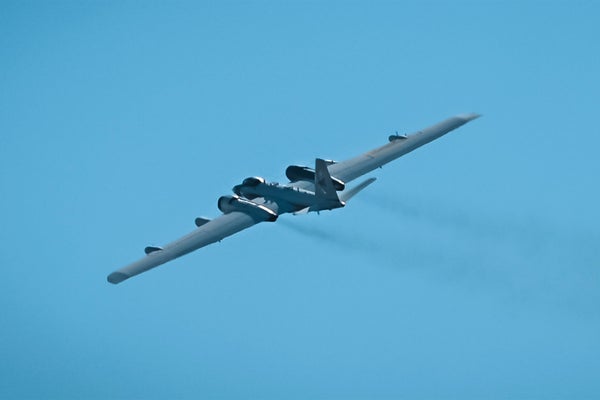
Its main vehicle will be a converted Air Force bomber initially designed over 70 years ago to operate in the upper atmosphere at the start of the Korean War. The latest version of this slim, twin-engine jet, called the WB-57 — whose ancestors also saw action as the B-57 in Vietnam — has been modified to carry a cargo of 17 different sampling instruments.
The United States hopes the mission will provide more data to help it and other members of the United Nations engage in an informed debate about solar geoengineering.
“We have to know more about how aerosols act in the climate system to better understand the costs and benefits of climate intervention,” said Karen Rosenlof, a senior scientist at NOAA’s Chemical Sciences Laboratory, in a statement released last week.
“We are already seeing detrimental impacts on the biosphere and the economy due to climate change, and we should expect that they’re only going to get worse.”
After completing research flights over Alaska and the Arctic, NOAA plans to have the WB-57 explore the stratosphere over the tropics in 2024 and then move to the Southern Hemisphere for more flights in 2025.
The converted bomber, packed from nose to tail with instruments designed by NOAA, NASA, Harvard University and the University of Vienna, is designed to answer questions raised last year by U.N. leaders. A report by the U.N. Environment Programme last month noted that the evidence needed to make informed decisions about large-scale deployment of solar radiation modification is “simply not there.”
Previous U.S. studies of what is called solar radiation modification have been done to explore the impacts of massive volcanic eruptions, large wildfires and the reductions of global emissions during the Covid-19 pandemic.
They have demonstrated that there is more learning to be done. The exploration of the stratosphere, which starts at four miles high over Alaska, may be the beginning of a much-needed learning curve.
Scientists who have explored the subject first felt that the dark clouds from volcanic eruptions were the most likely natural forces to shade the Earth, but much of the massive clouds of rock particles, smoke and earth heaved into the upper atmosphere quickly fell back to Earth.
A study led by the National Center for Atmospheric Research published in July 2021 tested another theory: that the reduction of emissions resulting from less travel, lockdowns and other drops in CO2 emissions during Covid-19 did the most cooling.
They didn’t. The study showed that large bushfires in Australia 2019 and 2020 were at least four times more potent than the Covid results because they moved into the Northern Hemisphere, temporarily shading the entire globe with sulfates and smoke particles that collected in clouds and lingered for as long as eight months.
John Fasullo, a scientist at the National Center for Atmospheric Research and the lead author of the study, noted that major volcanic eruptions happen about once in every 30 years, while major wildfires occur every couple of years. “We clearly need to learn more about how they affect global climate,” he said.
The U.N. report, drafted by nine scientists, looked at other global cooling alternatives, such as injecting large amounts of aerosols into the upper atmosphere, painting the rooftops of urban buildings white, planting more solar-reflecting crops, covering deserts with solar-reflecting materials and launching mirrors into space that could reflect more sunlight away from Earth.
Most of the projects would cost billions of dollars, take years to reach fruition and even then it’s uncertain how effective they would be. For a discussion by the U.N. General Assembly, “we need to have a more credible evaluation of ’what would happen if,’” said David Fahey, director of NOAA’s Chemical Sciences Laboratory, in an interview.
“One of the forks in the road is: Are you going to discuss an outdoor experiment? That’s where some people draw a line. This document decides some outdoor research may be necessary. We’re just kind of connecting the dots, but we’re not offering a solution,” he added.
He said the next U.N. move would be appointing a panel to decide how the body might structure such a debate.
Reprinted from E&E News with permission from POLITICO, LLC. Copyright 2023. E&E News provides essential news for energy and environment professionals.