
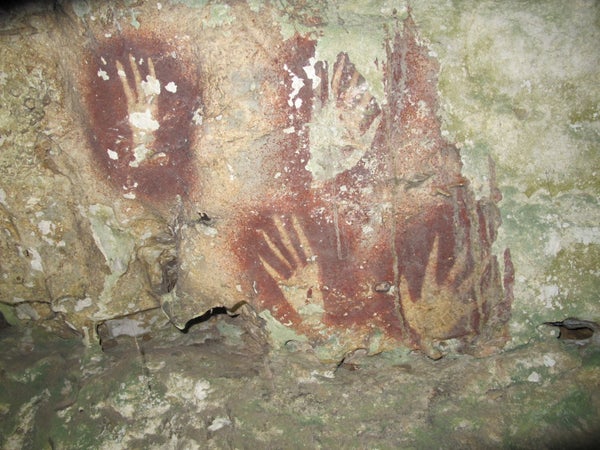
In an Indonesian cave system known for its prehistoric art, the oldest cave art yet found was hiding in plain sight. In a cave full of paintings that were well studied over the years, a faint hand stencil on the ceiling had been overlooked. A new chemical analysis of the stencil reveals that it dates back at least 67,800 years, an astonishing 15,000 years older than the next-oldest cave art found on the same island, Sulawesi. A nearby stencil dated to about 60,900 years ago.
“We knew that they were probably going to be old..., but we didn’t know how old,” says study co-author Maxime Aubert of Griffith University in Australia.
The record-breaking finding, published today in Nature, might provide valuable information about the first humans to reach Australia.
On supporting science journalism
If you're enjoying this article, consider supporting our award-winning journalism by subscribing. By purchasing a subscription you are helping to ensure the future of impactful stories about the discoveries and ideas shaping our world today.

Study co-author Shinatria Adhityatama working in the cave.
Maxime Aubert
The researchers used lasers—instead of the typical drilling—to take samples to date the art. This let them test more areas and therefore get a more accurate date range than they would have able to obtain with older methods.
The age of this previously undiscovered artwork is “really astonishing,” says Franco Viviani, a physical anthropologist who was not involved in the new study. Viviani adds that shifting back the time line of cave art gives us new insights into what ancient societies were capable of. “They confirm what is known today: that art is positively correlated to critical thinking and creative problem-solving skills,” he says.
Scientists were already aware of the ability of early humans and other ancient hominins to create art, such as shell jewelry made by humans at least 70,000 years ago and 57,000-year-old engraved bones attributed to Neandertals. Still, the cave art in the new study is among the oldest evidence yet of paintings by modern humans, and its distinctive style gives a view into the minds of the people who created it.
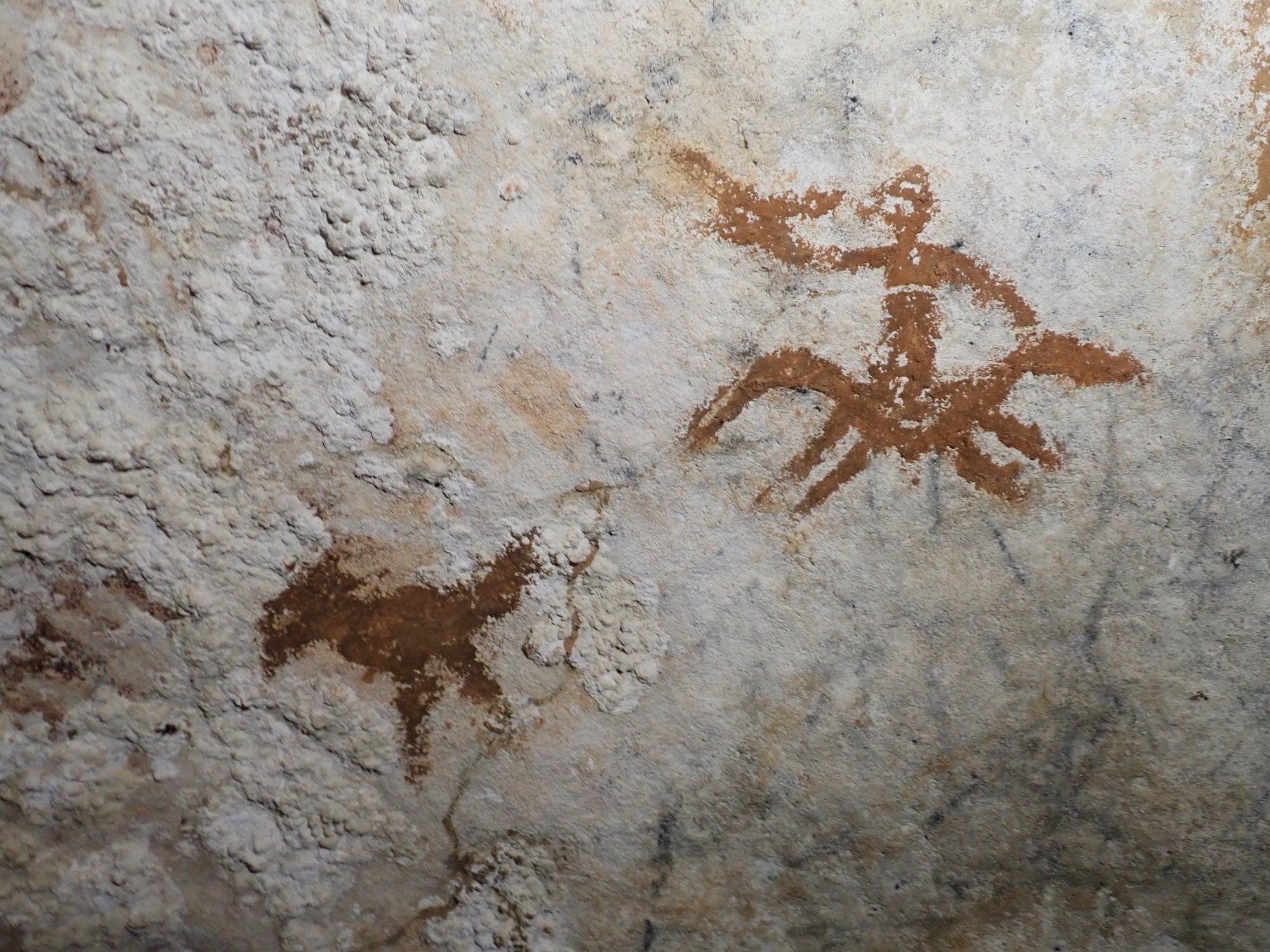
Figures seen on the cave walls.
Maxime Aubert
Consistent with a style that has, so far, only been found on Sulawesi, the hand is depicted with pointy, clawlike fingers. Researchers believe the style might serve to emphasize the close connection between humans and animals, which is “something we already seem to see in the very early painted art of Sulawesi, with at least one instance of a scene portraying figures that we interpret as representations of part-human, part-animal beings,” said study co-author Adam Brumm of Griffith University in a statement.
These clues about the culture of the people who created this art are especially interesting to researchers because they might shed light on the lives of the first humans to migrate to Australia. Archeologists have long suspected that Australia’s first settlers traveled through Indonesia, but because of uncertainties in DNA and archeological evidence that has been discovered to date, they have debated whether this happened 65,000 or 50,000 years ago. The presence of such old art suggests humans likely made their way to the continent even earlier, possibly managing to undertake the first intentional long-distance sea crossing.