
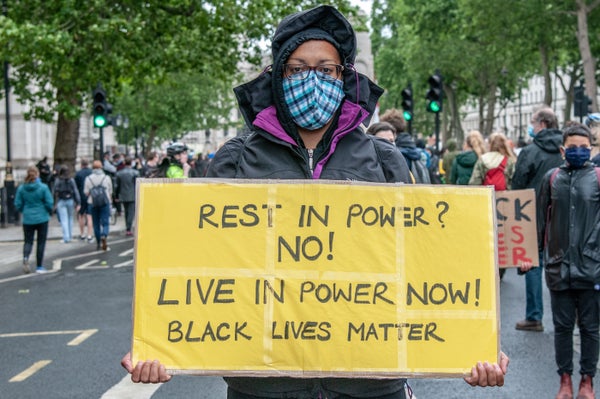
By now, you have received a statement about the current state of race relations from almost every institution and organization that you are affiliated with. Like me, you may be asking yourself: Will these statements mean anything? Will these organizations actually do something? Universities and scientific organizations are not just expected to say something, but to take action.
Academic institutions and scientific organizations must confront race relations while navigating the difficulties of a pandemic and economic strife. They should also aknowledge their role in perpetuating systems of racial oppression. It should not have taken this long for them to realize that something had to be said, and it should not take long for something to be done. What, then, can the organizations that serve as homes to many of us in the scientific community do?
EMBRACE MOBILIZATION
On supporting science journalism
If you're enjoying this article, consider supporting our award-winning journalism by subscribing. By purchasing a subscription you are helping to ensure the future of impactful stories about the discoveries and ideas shaping our world today.
Scientists are increasingly involved in efforts to bring about social change. Thousands have joined organizations like the Union of Concerned Scientists, Scholars for Social Justice and the Scholars Strategy Network. Young scholars of color created new organizations like the March for Science, 500 Women Scientists and Reclaiming STEM.
On June 10, hundreds of scientists went on strike in solidarity with the fight to make all Black Lives Matter. While these actions may have caused some university leaders to lose some sleep, they need not see this as a threat. Institutions shouldn’t shy away from collective action. Rather, they should embrace it.
Organizing builds better democratic governance and more representative institutions. Civic organizing contributes to enhancing societal democracy. Collective action makes institutions more responsive to their constituents and representative of marginalized groups.
Mobilization is not at odds with our educational mission. Activism fulfills a crucial pedagogical function as it enables participants to engage in the democratic process. Many of these lessons cannot be imparted within the confines of our now-empty university halls.
The institutions and organizations that we affiliate with must embrace collective action. Minority protest has an impact on policy, including policies aimed at stopping racist violence. Social movements drove countries to take action against issues of gender inequality.
Institutional leaders can take steps to support scientist mobilization. Educators should encourage young people to participate politically. At the very least, universities must commit to refraining from adopting disciplinary measures against those who choose to engage in collective action in the workplace, such as strikes, walkouts and public intellectualism. Yet, academic institutions must go well beyond merely refraining from repressing science activism. They can include civic engagement and service to the community in their tenure and promotion guidelines, hire and retain scholars of color, support research on race relations, and allocate resources for organizations working to address societal problems.
INACTION IS POLITICAL
It is not uncommon to see cautions against becoming political in the sciences. What these cautions fail to grasp, or choose to ignore, is that policy is a course of action or inaction. Inaction is political. Hence, inaction and silence are policies. By virtue of suppressing political activity or deciding not to engage in it, scientific organizations and institutions are being political. Insofar as the status quo is unequal, leaving things as they are is a regressive political act.
SCIENTIFIC ORGANIZATIONS MUST ALSO ACT
Universities are not the only ones who must act. Science organizations and scientific societies risk losing their legitimacy when they fail to engage in critical self-reflection and to ask themselves how they reproduce internally the societal ills that they decry in their statements. To this end, they must take responsibility for justice and enact an intersectional solidarity organizing approach. Intersectional solidarity is a form of organizing that makes space for intersectionally marginalized leadership and adopts an affirmative advocacy agenda that prioritizes the issues of marginalized groups. In doing so, these organizations will demonstrate that the statements that they issued in recent weeks are not merely acknowledging what brought us to the critical juncture in which we find ourselves, bur rather, are taking action to enact lasting social change.
ENACT CRITICAL DIVERSITY
The word diversity is now anathema to many minority scholars, not because they are against diversity in principle, but because they take exception to the ways in which diversity is celebrated but not realized. Loren Henderson and the late Cedric Herring pushed us to enact a critical diversity approach, which transcends celebrations of diversity to address power asymmetries between different social groups. While it matters to include and place minority leaders in leadership positions, resources must be allocated to make our organizations and institutions inclusive.
Diversity work should not fall exclusively on the shoulders of a chief diversity officer who is rarely given the resources and institutional support needed to fulfill their mission. The work of addressing the state of race relations should not continue to overburden devalued minorities and underrepresented groups. Institutions and organizations must create diversity infrastructures that generate ideas and are empowered to implement solutions. Those who engage in this work should be compensated for doing so.
WHICH SIDE ARE YOU ON?
Collectively, scholars have said: “This is not a moment to sit on the sidelines.” Beyond statements, scientific organizations must step into the fold and embrace the mobilization that will mark this juncture for years to come. Doing so is a democratic act.