
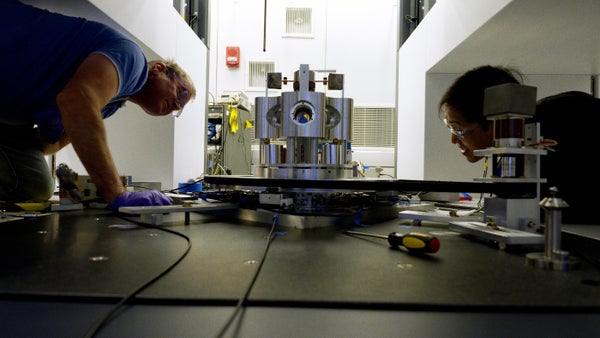
After 10 years of painstaking measurements, physicist Stephan Schlamminger stood in a hotel water park, waiting for a career-defining moment. His new measurement of the gravitational constant, or G, one of the most fundamental values in physics, was going to be revealed to his peers that afternoon. Hours before his talk, he took refuge amid the chlorine.
“I was so stressed out,” he says. “I almost wanted to cancel it.”
Just as Earth’s gravity pulls baseballs to the ground after they are thrown, all masses exert a gravitational force on other masses. But measuring the constant that determines the strength of that force is tricky, even for experienced scientists. On April 16 Schlamminger published a new measurement of G, adding another data point in the quest to determine its exact value.
On supporting science journalism
If you're enjoying this article, consider supporting our award-winning journalism by subscribing. By purchasing a subscription you are helping to ensure the future of impactful stories about the discoveries and ideas shaping our world today.
According to Isaac Newton’s law of universal gravitation, the gravitational force between two objects is the gravitational constant, G, multiplied by the product of the two masses divided by the square of the distance between them. In an equation, that looks like F = G(m1m2)/ r2.
The force of Earth’s gravitational pull, which can be found using this equation, is known as “little g.” Scientists have measured this constant to a high degree of precision with little disagreement: g = 9.80665 meters per second squared, or 9.80665 m/s2 at Earth’s surface. But “big G” is different. It’s the gravitational constant that is the same for all objects, no matter how massive. Previous measurements of G look like a scatter plot when they’re put together on a chart—the value still has a pretty large degree of uncertainty, Schlamminger says. That’s because it’s a very weak force, and isolating it is very difficult, even for our most cutting-edge instruments.
“G is kind of special,” Schlamminger says. “It’s like the lady clad in red velvet, it’s always wrapped in scandal.”
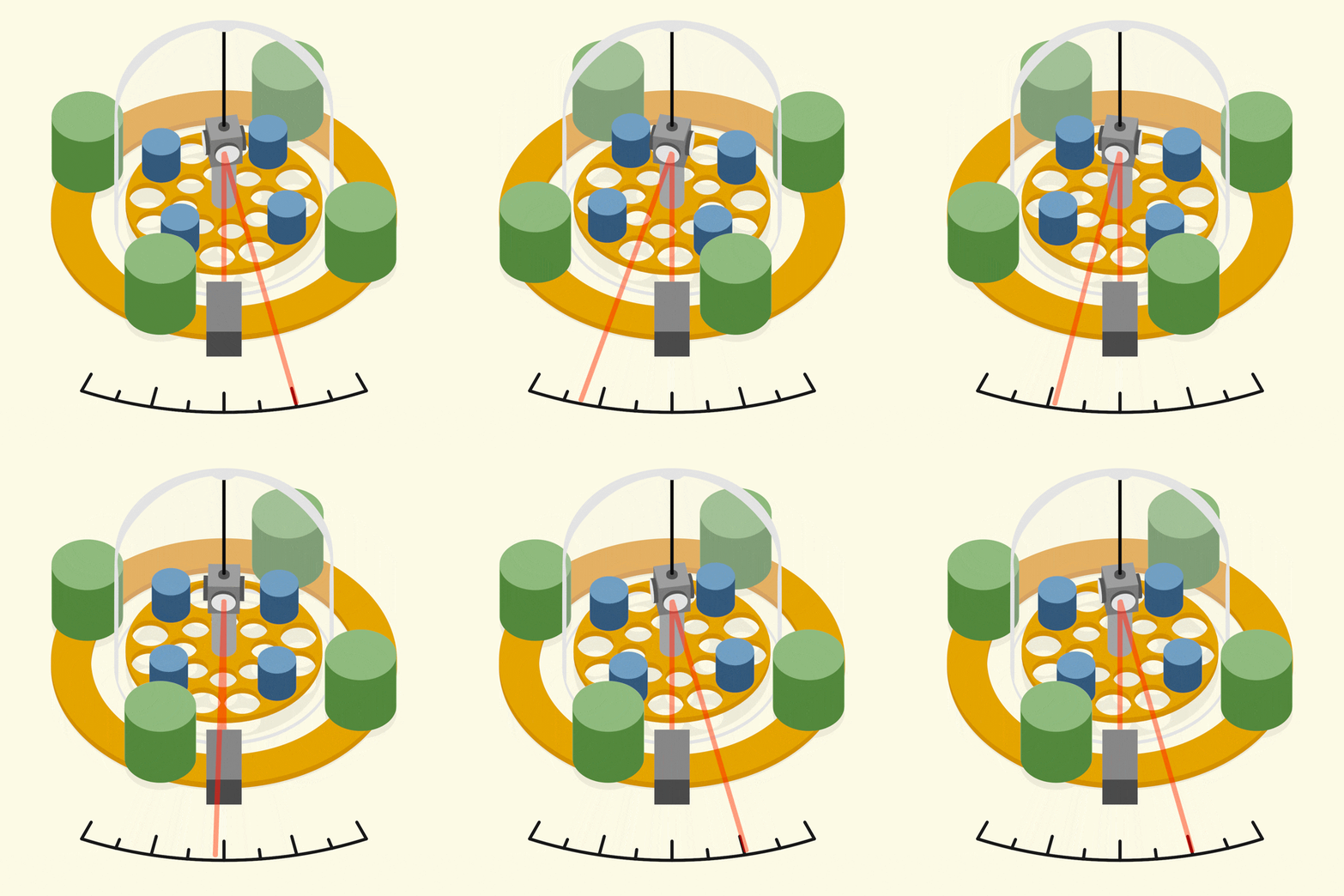
Schlamminger’s team repeated methods from a 2014 study from the International Bureau of Weights and Measurements (BIPM) and hoped for the same result. The measuring tool the researchers used in the new study is called a torsion balance, which is a modern update on a centuries-old method pioneered in the so-called Cavendish experiment. That experiment was originally designed to determine the density of the Earth. In it, a thin wooden beam with two lead balls on its ends was suspended from a wire at its center and then a structure that had heavier lead balls and was otherwise identical was stacked on top of the first beam. The result looked something like a weathervane. Instead of wind pushing the lead balls around, however, their mutual gravitational attraction caused them to twist toward one another. When they twisted, the angle of the beam balancing the small weights could be used to calculate the value of G.
Schlamminger’s version, which took place at the National Institute of Standards and Technology’s facilities in Gaithersburg, Md., used the exact same instrument and procedure as the 2014 BIPM setup. (BIPM sent it to NIST in 2016.) Researchers placed the masses on flat platelike objects called torsion disks, with the lighter masses on the inside suspended by a thin copper beryllium strip and the heavier masses located on a separate disk on the outside. Then they placed the whole apparatus inside a vacuum chamber. The arrangement was also a replication of the 2014 BIPM methods, but the team made some updates to it. For example, the scientists repeated the experiment with both copper and sapphire masses to eliminate effects from the type of material being used; replaced the apparatus’s torsion disk so the top and bottom were perfectly parallel; and rewrote the software suite for the device to improve instrument control.
Setup at NIST for measuring the strength of gravity.
S. Kelley/NIST
The final number they calculated for G, 6.67387 × 10⁻¹¹m3kg–1s–2, was lower than both the BIPM measurement and the internationally agreed-upon standard from the Committee on Data of the International Science Council (CODATA), which had been determined from a group of the best measurements taken so far. The result suggests that we still don’t know G as precisely as we’d like. “I think it’s always worth having one more measurement,” says Terry Quinn, former director of the BIPM and first author of the 2014 measurement study. But for most purposes, the CODATA consensus for G “is as good as we need at the moment,” he adds.
Measuring G is useful because it tests the quality of precision measurement instruments. The minor discrepancies among measurements may even point toward a yet-unknown mystery of physics, Schlamminger says. But the value itself, he admits, doesn’t have much practical use. Trying to determine the exact value of G is exciting for its own sake.
“I love taking measurements. Measurement science is my passion,” Schlamminger says. “I know it’s difficult to understand for many people, but it is. It can be exciting and very fulfilling.”