
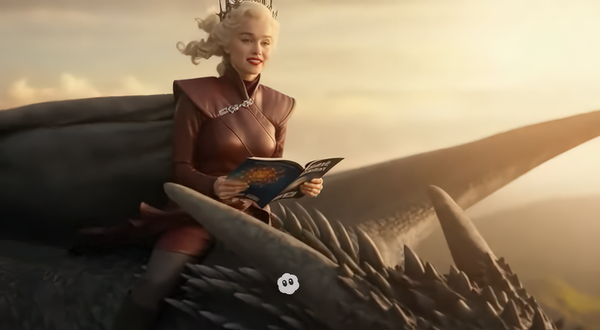
I didn’t think it would happen like this. I imagined Disney being first, testing artificial-intelligence-generated episodes using characters from libraries it licenses or owns. In an article last January, I wrote that AI would eventually let us generate new episodes of favorite series, casting our favorite stars—even those long gone, like Marilyn Monroe—in shows such as Game of Thrones. When I tested out OpenAI’s Sora 2 after its release on September 30, it gave me just that—Monroe as a dragon-riding Targaryen reading Scientific American. (Watch the video here.) Though AI-generated TV on demand hasn’t arrived yet, if the videos I’ve seen in Sora’s feed are any indication, users are hell-bent on creating it.
Unlike the original Sora, Sora 2 isn’t a mere video-generation platform; it’s a social app with a TikTok-style feed of short AI-generated clips, and it allows you to authorize a “cameo” of yourself so friends can drop your likeness into their skits—and to revoke it later once you’ve seen too many videos of yourself fleeing police or crying on game shows.
Sora 2 has remarkable interpretive powers. For instance, my short prompt asked for a woman who looks like Monroe riding a dragon while talking about how she would rather be a scientist than a dragon-riding, incestuous Targaryen. Though I offered no script, Sora 2 generated one that was surprisingly witty. Just as ChatGPT can generate entire screenplays in response to short, unspecific prompts, or follow long, detailed instructions, so too can the new Sora invent a complex scene on the basis of either.
On supporting science journalism
If you're enjoying this article, consider supporting our award-winning journalism by subscribing. By purchasing a subscription you are helping to ensure the future of impactful stories about the discoveries and ideas shaping our world today.
Within hours of Sora’s launch, the critics condemned it as “slop,” even as they generated their own content with the app, such as when YouTube’s Fireship channel posted a Sora-made clip of OpenAI CEO Sam Altman screaming, “Eat your slop, piggies,” to people kneeling before bowls of pig slop. As thousands of users began experimenting with the app, the sloppiness took many forms: surreal memes, mash-ups, inside jokes—and especially riffs on Altman. Altman stealing someone’s art and running for the door or peering through blinds in fear that Elon Musk was coming to take over OpenAI. People also began making clips of South Park that they compiled into episodes and posted elsewhere. Twice I ran across videos of the animated characters Rick and Morty cooking blue meth like Walt and Jesse in Breaking Bad. Though OpenAI initially said it would allow the use of copyrighted characters unless rights holders opted out, a wave of copyright complaints during the first two days prompted OpenAI to implement restrictions. Across social media, even as some people bemoaned AI “slop,” others complained that Sora was already dead—too throttled for any real creative expression.
If the mood feels familiar, it’s because we’ve seen this before. Early YouTube was an infringement engine until a lawsuit pushed it to fingerprint every upload. Twitch.tv and TikTok had their own reckonings with copyright violations, and most of social media was a smorgasbord of sloplike content—food pics, filtered selfies, meme farms and oversharing. For the platforms that survived, the arc bent from chaos toward systems that regulated the use of copyrighted material and rewarded creators for producing original work. Sora will need the same boring plumbing if it wants to graduate from novelty. But history tells us that platforms can evolve.
In a blog post this week, Altman explained that Sora is working to give “rightsholders more granular control over generation of characters” and find ways to monetize the platform and allow fan fiction. But what will make people keep using Sora after the novelty wears off? Personality is the driver behind much of today’s media—YouTubers, podcasters, old-fashioned celebrities and even animated characters. Sora’s “cameo” system hints at an evolving etiquette of consent and co‑ownership using the images of real people. Indeed, Altman, by virtue of the sheer number of spoofs, appears to have joined the pantheon of comic figures alongside South Park’s Eric Cartman and Family Guy’s Peter Griffin. (To prevent unauthorized deepfakes, the platform blocks image uploads of real people who aren’t the user and watermarks all videos.)
For all the talk of AI-generated slop, what we might be underestimating is not the power of AI but that of human creativity. People working at Mattel and Toys “R” Us are already using the technology to prototype characters, and Sora users can do the same with the figures from their own imaginations. Some are generating mini episodes of alien invasion or Mars colonization; and with better tools and dedicated channels, this sort of work could grow into monetized series with their own lore and beloved characters.
Other companies aren’t far behind: Meta recently released “Vibes,” an AI-generated social media feature that doesn’t include voices. Google’s Veo 3, which generates video with sound, offers the far less interactive Flow TV, and YouTube is already integrating AI tools to support creators. I could easily imagine Disney or Netflix with a similar interface to Sora’s that would let viewers spin off side stories from series and create prequels and sequels—and, above all, share those creations so that they can watch and remix one another’s contributions. But users will crave more than fan fiction, and Sora seems well placed to become TV on demand, enabling them to design original content that they want to watch and share. If history is a guide, the social media platforms that thrive are those that support and protect human creativity—in this case, the creativity to make the TV and movies you always wished existed.