
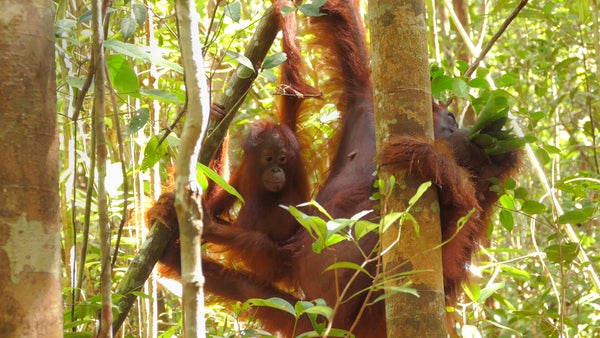
Medicine is not exclusively a human invention. Many other animals, from insects to birds to nonhuman primates, have been known to self-medicate with plants and minerals for infections and other conditions. Behavioral ecologist Helen Morrogh-Bernard of the Borneo Nature Foundation has spent decades studying the island's orangutans and says she has now found evidence they use plants in a previously unseen medicinal way.
During more than 20,000 hours of formal observation, Morrogh-Bernard and her colleagues watched 10 orangutans occasionally chew a particular plant (which is not part of their diet) into a foamy lather and then rub it into their fur. The apes spent up to 45 minutes at a time massaging the concoction onto their upper arms or legs. The researchers believe this behavior is the first known example of a nonhuman animal using a topical analgesic.
Local people use the same plant—Dracaena cantleyi, an unremarkable-looking shrub with stalked leaves—to treat aches and pains. Morrogh-Bernard's co-authors at the Czech Academy of Sciences, Palacký University Olomouc and the Medical University of Vienna studied its chemistry. They added extracts from it to human cells that had been grown in a dish and had been artificially stimulated to produce cytokines, an immune system response that causes inflammation and discomfort. The plant extract reduced the production of several types of cytokines, the scientists reported in a study published last November in Scientific Reports.
On supporting science journalism
If you're enjoying this article, consider supporting our award-winning journalism by subscribing. By purchasing a subscription you are helping to ensure the future of impactful stories about the discoveries and ideas shaping our world today.
The results suggest that orangutans use the plant to reduce inflammation and treat pain, says Jacobus de Roode, a biologist at Emory University, who was not involved in the study. Such findings could help identify plants and chemicals that might be useful for human medications, de Roode says.
In creatures such as insects, the ability to self-medicate is almost certainly innate; woolly bear caterpillars infected with parasitic flies seek out and eat plant substances that are toxic to the flies. But more complex animals may learn such tricks after an initial discovery by one member of their group. For example, an orangutan may have rubbed the plant on its skin to try to treat parasites and realized that it also had a pleasant pain-killing effect, says Michael Huffman, a primatologist at Kyoto University, who was not involved in the new research. That behavior may then have been passed on to other orangutans. Because this type of self-medication is seen only in south-central Borneo, Morrogh-Bernard says, it was probably learned locally.