
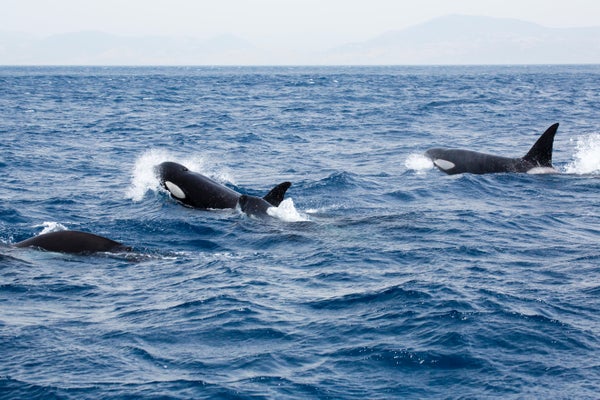
The orcas are at it again.
A group of the highly social marine mammals, also called killer whales, attacked and sank a 50-foot-long sailing yacht on Sunday, the New York Times reported. Two people had to be rescued from the waters near the Strait of Gibraltar.
The incident was yet another in a startling spate of such attacks by orcas (Orcinus orca) in the area since 2020—an apparently emerging phenomenon that has researchers stumped.
On supporting science journalism
If you're enjoying this article, consider supporting our award-winning journalism by subscribing. By purchasing a subscription you are helping to ensure the future of impactful stories about the discoveries and ideas shaping our world today.
“It is a rare behavior that has only been detected in this part of the world,” said Alfredo López, an orca researcher at the Atlantic Orca Working Group (GTOA), in an interview with Scientific American last year.
In the more than 500 cases GTOA has documented of orcas reacting to boats, most often the animals have only approached the vessels. In the fraction of reports that have included physical interactions, the orcas have usually bit at a vessel’s rudder. The attacks have usually lasted less than 30 minutes, but some have gone on for up to two hours.
So far there are two main hypotheses regarding the baffling behavior. One is that it is a fad, which orcas seem to engage in just like humans do. Orcas in one Pacific Northwest group famously spent the summer of 1987 sporting dead salmon on their head, for example.
The other is that the new trend stems from past negative experiences with boats, which can strike and severely harm marine animals. The Iberian orca population is critically endangered; migration routes put its members in the path of many fishing, military and recreational vessels. But researchers caution against attributing malicious intent to animals. Deborah Giles, science and research director of the Washington State–based nonprofit conservation organization Wild Orca, previously told Scientific American that orcas in the Pacific Northwest were relentlessly pursued by humans in the 1960s and 1970s—but never attacked people or boats.
Scientists are gaining a greater awareness and understanding of the these clever predators by studying not only the boat attacks (which GTOA has said have declined overall so far this year, compared with previous ones) but also other behaviors. The first recorded instance of a group of orcas killing a blue whale was observed in 2019, and single orcas have been documented killing great white sharks. Recent research has also suggested that orcas in the Pacific Northwest should actually be recognized as two different species versus part of a single global species. It is possible that other groups that are currently considered subpopulations of that one species are also separate ones.