
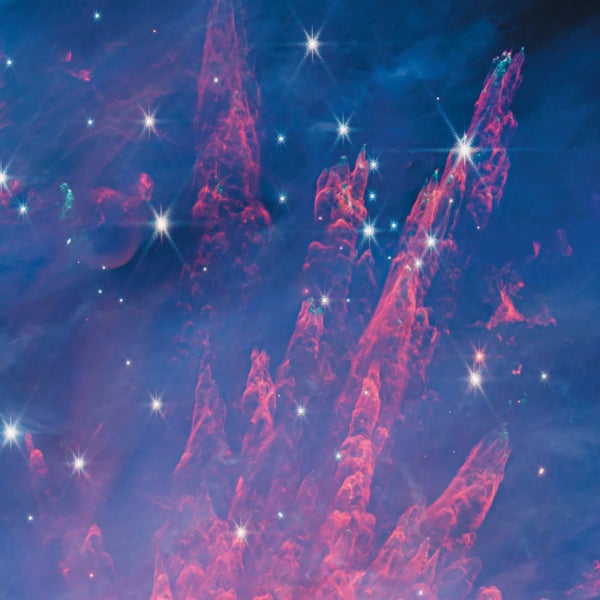
Strange, twirling duos of roughly Jupiter-size celestial bodies in the Orion Nebula have had astronomers scratching their heads since the James Webb Space Telescope (JWST) photographed them in October 2023. Unless they were violently ejected from a solar system—unlikely, given their delicate, undisturbed dance—the free-floating pairs challenge astronomers’ long-standing notion that planets can form only within a star’s orbit.
Researchers have now discovered radio-wavelength signals from one of these 42so-called Jupiter-mass binary objects (JuMBOs), according to a study in the Astrophysical Journal Letters, suggesting the pair is astoundingly bright. “It’s important to understand what these objects are, and having radio data really adds a new dimension to the problem,” says the study’s lead author, Luis F. Rodríguez, an astronomer at the National Autonomous University of Mexico.
When Rodríguez and his team heard about JWST’s discovery, they scoured public telescope data for unidentified radio-wave sources in Orion and found one that recurred three times over a decade in the exact same position as the pair known as JuMBO24. The signals suggest JuMBO24 isn’t moving quickly through the nebula, which would mean it might have indeed been born alone rather than blasted away from a star system.
On supporting science journalism
If you're enjoying this article, consider supporting our award-winning journalism by subscribing. By purchasing a subscription you are helping to ensure the future of impactful stories about the discoveries and ideas shaping our world today.
“The Orion Nebula is just so far away that I would never have expected there to be detectable radio emission,” says Melodie Kao, a planetary radio expert at the University of California, Santa Cruz, who was not part of the team. Large planets’ magnetic fields can capture electrons, building up a carousel of electricity that zips around their equators and beams out radio waves like an antenna. But it would take unprecedented power for JuMBO24’s signal to reach Earth. “This JuMBO would have to be extraordinarily bright—100 times brighter than anything we’ve ever seen,” Kao says. If confirmed, this attribute would make JuMBOs even more baffling because no ordinary planet’s magnetic field can sustain such a dazzling glow.
“I don’t think the last word has been spoken on this, but it’s a really intriguing paper,” says Jan Forbrich, an astronomer at the University of Hertfordshire in England. Forbrich was not involved in this study, but his 2012 discovery of the then unidentified radio source in Orion made it possible. Both he and Kao hope to see further radio surveys of this and other JuMBOs to confirm their status as powerful radio sources.
Rodríguez agrees that more radio telescopes should tune in to Orion’s station. He says JuMBOs may add to our understanding of where planets come from and how many there are. If such pairs can really form without a host star, he says, “it means there are probably a zillion planets in our own galaxy that we haven’t accounted for.”