
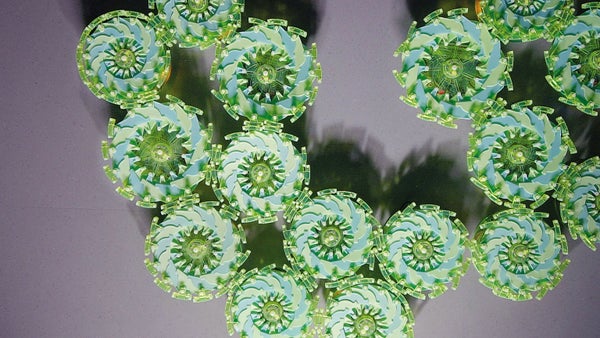
Scientists have created a robot consisting of multiple units that can operate as a cluster, responding to stimuli and acting on their environment without the need for any centralized control—much like living cells.
Each of the circular units, or “particles,” measures up to 23.5 centimeters in diameter. The particles are loosely joined together with magnets and can move only by expanding or contracting. But despite their individual simplicity, as a group they are capable of more sophisticated behavior, such as moving toward a light source. The weakly linked mass is more resilient than many other robotic systems because it has no single point of failure and can keep working even if some individuals become disabled, the researchers reported in March in Nature.
The scientists say miniaturized versions of the particles could be used in search and rescue operations—for example, spreading sensor-equipped units over the debris field of a collapsed house to find buried victims. Tiny units could also deliver drugs to hard-to-reach parts of the human body or boost research by modeling the cellular action involved in organ formation.
On supporting science journalism
If you're enjoying this article, consider supporting our award-winning journalism by subscribing. By purchasing a subscription you are helping to ensure the future of impactful stories about the discoveries and ideas shaping our world today.
The prototype particles are equipped with light sensors and simple electronics that make them expand or contract in accordance with an algorithm. Each particle measures the intensity of nearby light and broadcasts that reading to its neighbors. By comparing how much light it detects relative to the others, each unit decides when to start a cycle of expansion and contraction—causing them all to move as a group.
The researchers created clusters of up to 24 particles and showed they could shuffle toward a light source—a kind of motion comparable to the way living cells aggregate and migrate for wound healing and other functions. “In our system, each particle is very simple, and there is no central control over the cluster,” says Daniela Rus, director of the Computer Science & Artificial Intelligence Laboratory at the Massachusetts Institute of Technology and one of the team leaders. The units “work together without relying on any particular individuals.” (Rus serves on Scientific American's board of advisers.)
The robot can also skirt obstacles and push objects around. And in simulations with up to 100,000 units, even if 20 percent stopped functioning the cluster could still travel at about half of its top speed.
“This kind of technology is expected to be applied to tasks such as searching, collecting and transmitting information and transporting [objects] as a swarm,” says Hajime Asama, a professor of engineering at the University of Tokyo, who was not involved in the study. “But there are still many problems to be solved before reaching actual applications, including the ability to adapt to changes in tasks, the environment and the robot's own state.”