
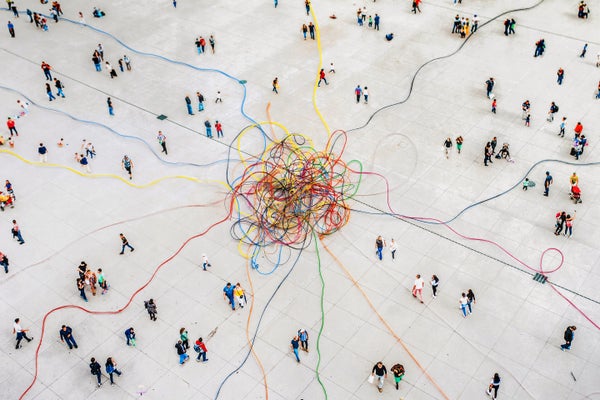
Humans walking in crowds tend to form orderly lanes. It’s something we do “without even knowing [why],” says Iker Zuriguel, a physicist at the University of Navarra in Spain. But sometimes, such as in crosswalks during peak commuting times, that order turns to utter chaos. Mathematicians used physics models and gymnasium experiments to understand why and pinpointed a specific “critical angle” of the crowd’s movement—13 degrees—to explain why crowded pathways snarl to a standstill.
This knowledge isn’t just useful at rush hour. “Managing a crowd [efficiently]—in train situations, concerts, even in the streets—is very important” for safety and city building, explains Zuriguel, who wasn’t involved in the new study. In the recent paper, published in Proceedings of the National Academy of Sciences USA, mathematicians asked participants on either side of a gymnasium to walk to the other side without colliding with anyone. Each participant wore a little paper hat with a barcode to track their movements.
On supporting science journalism
If you're enjoying this article, consider supporting our award-winning journalism by subscribing. By purchasing a subscription you are helping to ensure the future of impactful stories about the discoveries and ideas shaping our world today.
The researchers considered each person as a “particle” in a physics model—a method they had previously used to show that people in crowds would form orderly lanes. But obviously this doesn’t always happen in real life. “Humans are not perfect particles; we’re idealizing them somewhat,” explains study co-author Karol Bacik, an applied mathematician at the Massachusetts Institute of Technology. “They have some free will” and often different destinations or goals. People form these lanes as it “suits them, and then they can split off again,” adds study co-author Tim Rogers, a mathematician at the University of Bath in England.

In experimental work, the researchers recorded the movements of pedestrians using an overhead camera.
Karol Bacik, MIT
The researchers wanted to test what factors disrupted the naturally occurring lanes. At first, Bacik and Rogers considered that a few “outliers” running across the lane randomly could be to blame, but they found that there was no strict number of people that needed to deviate from their lane for foot traffic to start breaking down. The researchers instead measured the deviation of the entire crowd by averaging the angles at which each participant was walking to obtain what they called the crowd’s angular spread. In the crowded gym, the researchers instructed participants to act out different scenarios. In one round, they were all told to walk as straight across as possible—or with essentially zero degrees of deviation. This led to lane formation, as expected. But in other trials, each participant was directed to veer in different directions, increasing the crowd’s angular spread.
Only when the crowd’s average walking angle hit 13 degrees from a straight line did the flow break down into a completely random structure—in other words, chaos. This may seem like a relatively small deviation from “head-on,” and indeed, it’s less than the angle of a pencil tip. But that average deviation was enough for participants’ paths of travel to severely intersect, causing people to pause, sidestep, and reroute and impeding the easy flow.
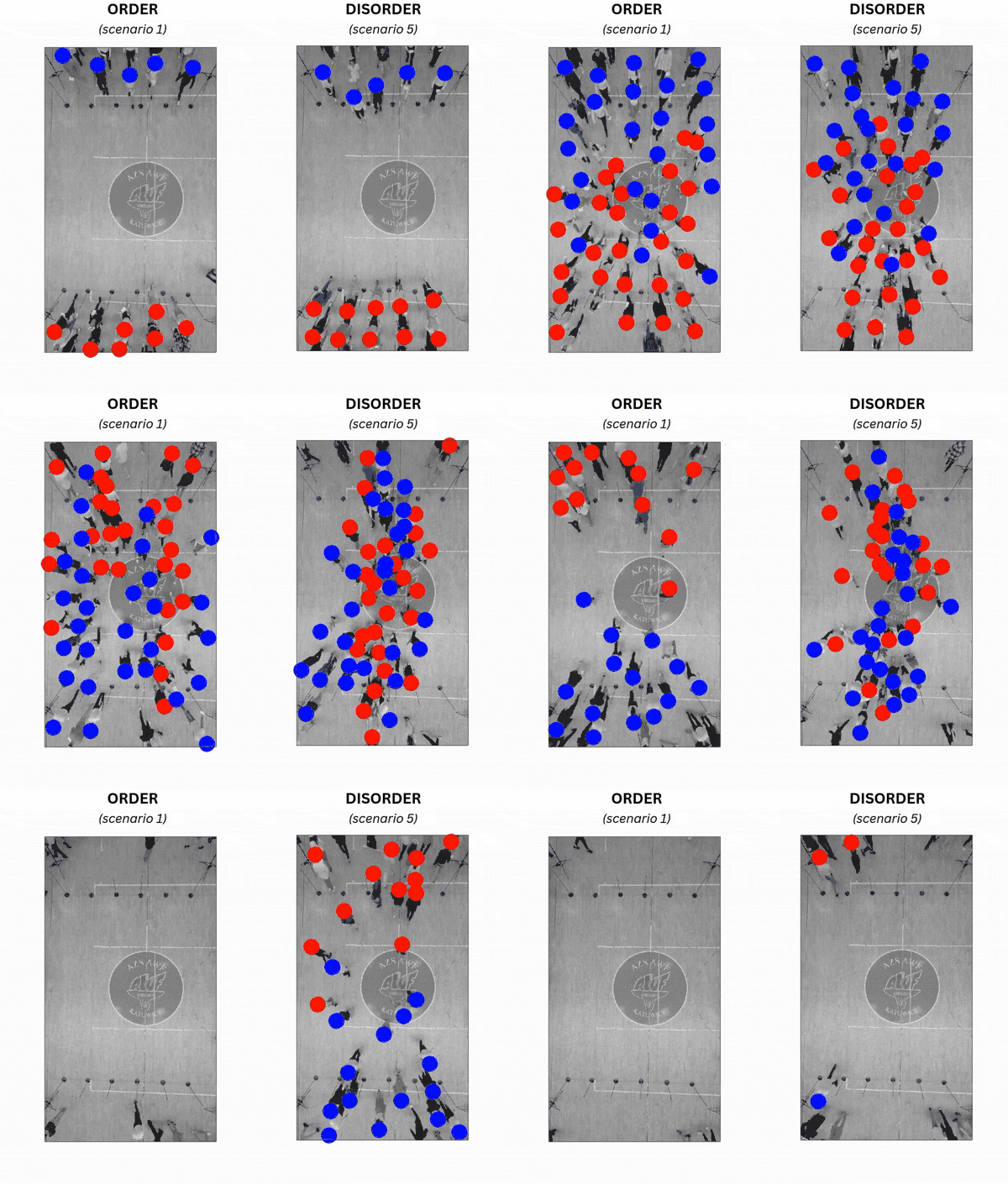
Crowd flow - from order to chaos. In experimental work, the researchers recorded the movements of pedestrians using an overhead camera.
Karol Bacik, MIT
That said, knowledge of this “chaos” angle would be more useful for civil planners and engineers than individual pedestrians, who can control their own behavior but not that of others. In the real world, “every situation will be different,” Rogers says. But taking into account the physics and math of lane formation when spaces are designed—be they gymnasiums, stadiums, sidewalks or crosswalks—offers an additional perspective on how people move in crowds.
“When people are designing spaces that pedestrians are going to use,” Rogers says, “they might want to think about what cues there are, what kind of restrictions of motion there are, what kind of destinations and origins are in this space ... considering angular spreads [will give] more chance for nice, smooth lanes to be the norm.”