
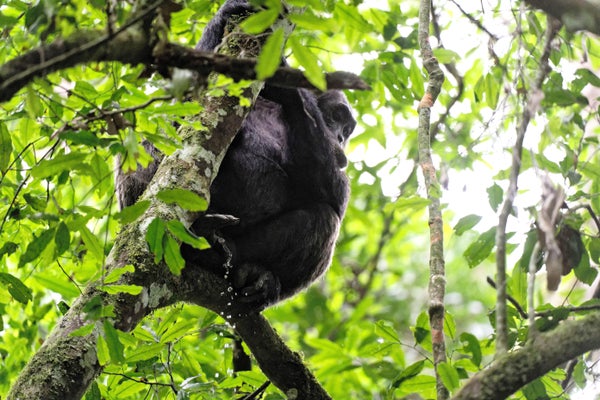
Some primates pee together. Ena Onishi already knew that—Japanese even has a word for when humans go off to the restroom together: tsureshon. Still, Onishi became curious when she noticed the behavior among the chimpanzees she was observing as a doctoral student at Kyoto University Wildlife Research Center. She knew about well-studied “contagious” behaviors, such as yawning in humans, and wondered whether the chimps might be displaying “contagious urination.”
In a new paper, published on Monday in Current Biology, Onishi and her co-authors found that “monkey see, monkey do” does indeed appear to hold true for these chimpanzees (even though they’re not technically monkeys). Even more intriguingly, each animal’s status in the social hierarchy seems to influence which one pees and when. The finding represents the first known scientific study of contagious urination, according to the authors.
“It’s not something I would have ever thought to study, for sure,” says Matthew Campbell, a psychologist at California State University Channel Islands, who was not involved in the new research but has studied contagious behavior in chimpanzees. “I thought it was clever and novel, and it leads to a lot of interesting questions.”
On supporting science journalism
If you're enjoying this article, consider supporting our award-winning journalism by subscribing. By purchasing a subscription you are helping to ensure the future of impactful stories about the discoveries and ideas shaping our world today.
Onishi and her colleagues studied 20 chimpanzees, mostly males, that lived in four groups in Kyoto University’s Kumamoto Sanctuary between 2019 and 2021. The researchers gathered more than 600 hours of video footage of the endangered primates, then identified when each animal peed and where they were at the time. “It was a bit overwhelming because I didn’t know if I would get meaningful results or if all that effort would end up being for nothing,” Onishi says. “It was definitely nerve-racking at times!”
“On the surface, it may seem like a silly topic, but it actually gets at something that’s rather fundamental.” —Matthew Campbell, psychologist
By comparing the observations with computer simulations of randomized peeing, Onishi and her colleagues determined that, indeed, the chimpanzees were more likely to urinate within 60 seconds of one another than they would if they were behaving randomly. Distance also mattered: animals within just a few feet of the first chimp to go were much more likely to follow suit than chimps located 10 or more feet away.
But perhaps the most interesting analysis came when Onishi and her colleagues considered social relationships among the peeing chimpanzees. They were surprised to find that a chimp that was pals with the first animal to pee wasn’t any more likely to follow suit. But a chimp that was less dominant than the first to go was more vulnerable to contagious peeing.
“I initially expected that if social influences existed, they might resemble those seen in yawning—such as stronger contagion between socially close pairs,” Onishi says. “Instead we observed a clear influence of social rank, with lower-ranking individuals being more likely to follow the urination of others.”
The new paper is just a first report, so plenty of additional research is needed to understand the phenomenon—and what insight it sheds on chimpanzees’ lives. For example, scientists could do a similar analysis in wild animals, although Onishi expects the results would likely be consistent. Campbell also wonders whether the apparent synchronized peeing led by dominant chimps merely reflects the group’s daily routines, in which relocations are orchestrated by the leading animal and may prompt a pre-road-trip bathroom stop.
Study co-author Shinya Yamamoto, a professor at Kyoto University, says that the finding makes him think about chimps a little differently. “This strengthens my impression of chimpanzees as ‘social animals,’” he says. “This study shows that even their physiological aspects are influenced by their social contexts.”
Campbell notes that depending on how precisely the behavior is transmitted between animals, the finding may also help to reveal how a chimpanzee understands its own body and whether it has a concept of urination. “How this is working and what it means for the mental life of a chimpanzee, that’s really the intriguing part to me,” he says. “On the surface, it may seem like a silly topic, but it actually gets at something that’s rather fundamental.”