
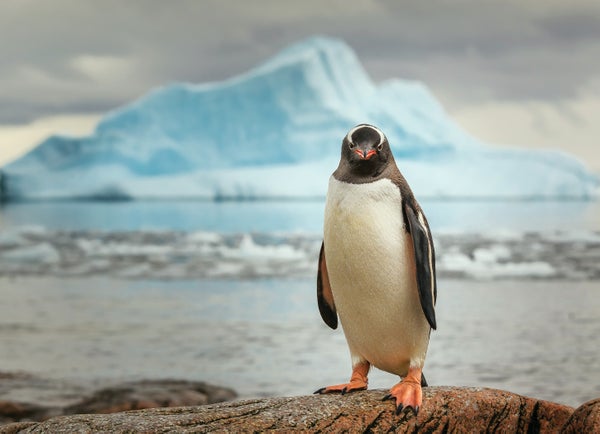
When Philip Sontag first visited Antarctica as a Ph.D. student, he brought back an unusual souvenir: a huge bag of penguin feathers. And now, after a decade-long analysis, Sontag and his colleagues have figured out how to use such feathers to create a living map of the mercury contamination that increasingly threatens Southern Hemisphere wildlife.
Mercury is a common by-product of gold mining, a growing industry in several southern countries. The toxic metal accumulates as it moves up the food chain by binding with amino acids in animals and then infiltrating their central nervous systems, where it can inhibit neural growth. Tracking mercury exposure is crucial for monitoring an ecosystem—but merely sampling rocks, ice or soil for its presence tells little about how much is actually entering the food web.
Many predators, including penguins, have evolved ways to dispose of mercury. The chemical builds up in feathers that the birds regularly molt in large quantities. Sontag, now a polar researcher based at Rutgers University, and his colleagues hoped to use molted feathers to determine where penguins picked up the toxic substance. The scientists were surprised to find a very clear correlation between the feathers’ levels of mercury and of a carbon isotope called carbon-13; the latter varies based on geographic location and thus acts as an indicator of “where the penguins are feeding or where their breeding grounds are,” Sontag says. These findings, published in Science of the Total Environment, confirmed this connection in seven penguin species scattered across the Southern Ocean—a pattern suggesting they’re exposed to more mercury farther north, where the comparatively warmer environment leads to higher carbon-13 levels.
On supporting science journalism
If you're enjoying this article, consider supporting our award-winning journalism by subscribing. By purchasing a subscription you are helping to ensure the future of impactful stories about the discoveries and ideas shaping our world today.
These findings suggest that penguins could function as mercury bioindicators: living trackers of environmental pollutants, says the study’s senior author John Reinfelder, a marine biologist at Rutgers. Rather than measuring the chemical itself in a snapshot of time and place, he says, measuring penguin feathers’ mercury levels tracks the substance’s movement through the oceanic food web. For instance, penguin species known to reside near one another had varying mercury and carbon-13 levels because of their different migration and feeding patterns. These data could be modeled into a maplike database to help guide future projects on conservation and polar science research.
Scientists consider penguins promising candidates for such bioindicators, says marine scientist Míriam Gimeno Castells, a Ph.D. student at the Institute of Marine Science from the Spanish National Research Council, who was not involved in the study. The animals are midway through the food chain. They breed in colonies, so researchers can easily scoop up feathers from many different individuals. Additionally, every breeding season they undergo dramatic molts; the feathers they lose “will contain the mercury that has accumulated during the nonbreeding season,” Gimeno Castells says.
Sontag’s next steps are to collect newer feathers to experiment with, across different species, and to measure mercury in penguins’ blood and prey to compare with levels of the substance in their feathers.
And how are the penguins themselves doing with their current mercury levels? “We don’t believe penguins have been exposed to toxic levels as of yet,” Reinfelder says. “Yes, the penguins will be okay.”