
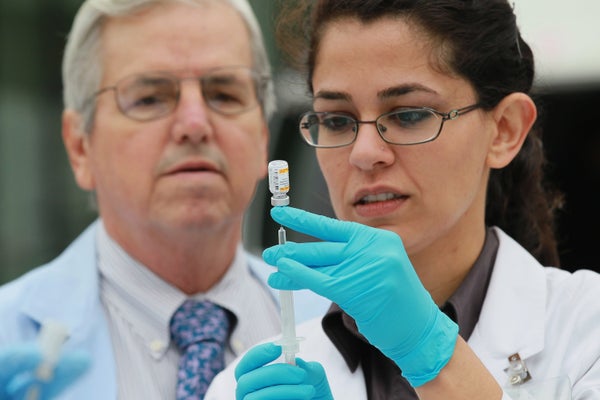
Americans trust vaccines scientists as much as they do other scientists, a new U.S. survey finds, despite a decline in vaccination rates and a proliferation of attacks on vaccines in both the wake of the COVID pandemic and the rise of figures such as Robert F. Kennedy, Jr., a noted vaccine skeptic.
The results come as the Trump administration is reportedly pivoting away from attacks on vaccines, following other polling that has found broad voter support for immunization.
Roughly seven in 10 people have “a moderate or greater amount” of trust that vaccine scientists act in the public interest, according to the new poll, which was conducted by the University of Pennsylvania’s Annenberg Public Policy Center (APPC). The survey, which included 1,650 people, asked, “How much, if at all, do you trust scientists working on vaccines to act in the best interest of people like you?” and found that 69 percent of participants reported great or moderate trust. That matches statistical data on trust in medical researchers and scientists in general and is in line with past measures of trust in scientists.
On supporting science journalism
If you're enjoying this article, consider supporting our award-winning journalism by subscribing. By purchasing a subscription you are helping to ensure the future of impactful stories about the discoveries and ideas shaping our world today.
“The public has an anchored awareness of the benefits of vaccination,” says APPC director Kathleen Hall Jamieson. That should be reassuring to public health experts who have voiced increasing concern that the U.S.’s decades of success in eliminating diseases such as polio and measles may have made the public unaware of vaccination’s benefits, she says.
At the same time, under Kennedy’s leadership, the U.S. Department of Health and Human Services has sought to limit vaccines, including several childhood shots. Meanwhile measles has broken out across the U.S., killing three people last year, while pertussis, or whooping cough, has been linked to at least 16 deaths last year.
“I don’t think the results of the survey are surprising; [Kennedy] does not represent the views of most people,” says vaccine expert Paul Offit of the Children’s Hospital of Philadelphia. “Most people get their children vaccinated because they want them to be safe, despite the loud voices.”
“We still have a lot of concerns” amid increasing outbreaks of vaccine-preventable disease, especially in communities with low inoculation rates, Offit says.
More broadly, there’s a “misperception” that trust in science has eroded specifically since the pandemic, Jamieson says. Science remains among the most trusted U.S. institutions, ranking with the military and firefighters for trust. Crucially, the new survey suggests scientists need to be more aware that some people think that science has unintended consequences and believe that scientists feel “superior” to others. Vaccine scientists scored slightly better on these accounts than other researchers, but the discipline overall should pay attention to this feedback, Jamieson says.
Editor’s Note (4/27/26): This story is in development and may be updated.