
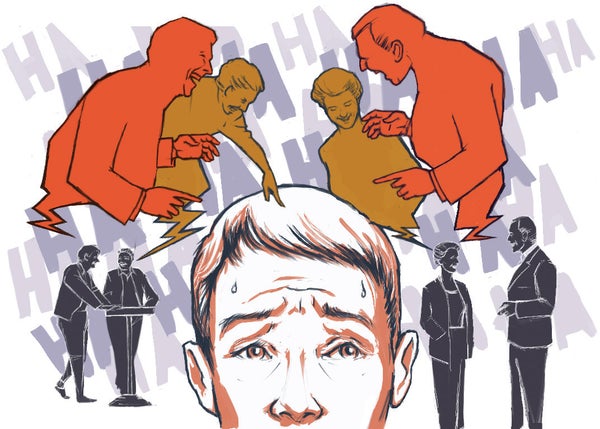
Humor has been touted as a panacea that boosts the immune system, smooths the way to success at work and even helps us to live longer. But for some people, chuckles are no laughing matter.
Those who suffer from gelotophobia, or fear of being laughed at, dread even well-intentioned jokes. “They don't trust friendly laughter—that someone is just enjoying themselves. Any laughter is bad laughter,” says psychologist Willibald Ruch of the University of Zurich, who pioneered research on the unusual condition in the mid-2000s. Ruch recalls one case he observed in his laboratory: “This person would always wait for the next bus if no seat in the last row was free. He couldn't stand the idea that someone would sit behind him and laugh.”
Like most phobias, this one exists on a spectrum from mild to severe. To assess the extent of the problem, scientists ask people to rate how much they identify with statements such as “It takes me very long to recover from having been laughed at” or “When others laugh in my presence, I get suspicious.” Studies across the globe suggest anywhere between 1.6 and 13 percent of people suffer from gelotophobia. “We [see] the lowest numbers in countries where people are more equal, like Denmark and the Netherlands, and very high scores in countries where honor is particularly important and shame is used for social control,” such as some Asian countries, Ruch says.
On supporting science journalism
If you're enjoying this article, consider supporting our award-winning journalism by subscribing. By purchasing a subscription you are helping to ensure the future of impactful stories about the discoveries and ideas shaping our world today.
Researchers are just beginning to understand how gelotophobia develops. In addition to culture, parenting may play a role. In a study of 100 families, mothers and fathers who were prone to punishment and control were more likely to have kids who feared laughter. Several studies have shown that gelotophobes were often victims of bullying. Also, a 2012 study suggested a partial overlap with social anxiety, finding that 36 percent of gelotophobes meet the criteria for the disorder.
Brain-imaging studies show that gelotophobes process humor differently from other people. A 2016 electroencephalographic study revealed that when the former listen to the sounds of laughter or angry shouting, they show more activity along pathways linking their prefrontal and posterior cortices. The study's lead author, Ilona Papoušek, a psychologist at the University of Graz in Austria, believes this linkage shows they are “more sensitive to actual or supposed malicious aspects of laughter.”
Another experiment published in 2016 showed that compared with a control group, gelotophobes have lower activation in their brain's reward circuits when listening to jokes. It remains unclear, though, what comes first: gelotophobia or atypical processing of laughter in the brain.
The good news, Ruch suspects, is that gelotophobia should respond to the same kind of therapies used for other phobias. The bad news is it might be hard to convince someone who dreads laughter to visit a therapist, who might smile at patients to put them at ease.