
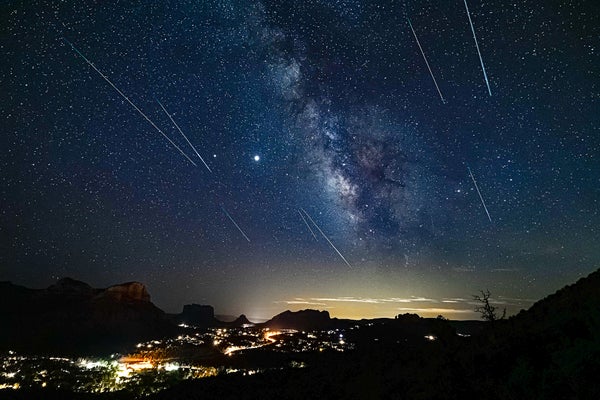
During the next few nights, you can witness countless pieces of a comet rain down on Earth.
But don’t be alarmed. It’s perfectly safe! This weekend, August 12–13, is the peak of the Perseid meteor shower, which offers dozens of “shooting stars” per hour. It is one of the best, most reliable meteor showers. And with no bright moon to interfere with this year’s show, it’s a great time to go outside and—at least figuratively—see the sky fall.
Meteor showers are one of the easiest astronomical phenomena to observe. The three most important things required are a dark site as far from city lights as possible, a wide-open sky and patience.
On supporting science journalism
If you're enjoying this article, consider supporting our award-winning journalism by subscribing. By purchasing a subscription you are helping to ensure the future of impactful stories about the discoveries and ideas shaping our world today.
The necessity of darkness should be obvious: most meteors are so faint that you need a decently dark sky to see them. You don’t need to set up camp on a remote mountaintop or anything like that, but being far enough from glowing billboards and streetlights to be able to see, say, magnitude 4.0 stars is a big help.
Meteors can appear anywhere in the sky, so you want to see as much of it as you can. Nearby trees or buildings will block your view toward the horizon, so try to find an open field or even a parking lot (if it’s not surrounded by lights!). The more sky you see, the better.
Patience is crucial, too. Even at its peak, showers of meteors such as the Perseids will only produce perhaps one shooting star per minute, and even half that number is considered a decent show. So don’t expect anything like meteor showers in the movies, where shooting stars streak across the sky every few seconds. But that’s fine! When it takes a minute or two between meteors, each one becomes a bit more special—and surprising. Give it time, and you’ll be oohing and aahing with everyone else.
Also important is when to go out. Given the celestial geometry of this year’s event, the ideal time is after midnight—the later, the better. The best show will occur after about 2 to 3 A.M. EDT, but you’ll still see some meteors even if you go out earlier.
Those are the basics. But details matter, too. You’ll probably want to bring something comfortable to sit or lie down on. And even in August the nights can be cool, so having a hot beverage on hand always helps (and makes things more festive). Having friends or family along is a good idea, too! Companionship helps the time pass during lulls in the spectacle overhead, and it’s fun when everyone sees the same bit of cosmic fluff streaking across the sky. When my daughter was little, I would take her out to watch the Perseids; it was fun for both of us, and she loved breaking the going-to-bed rules for a special occasion.
So that’s how you can see the Perseids. But what are you seeing?
Meteors in showers are small bits of material shed by a comet, which is basically a collection of rocks and ice all smushed together like a dirty snowball. Comets tend to have long, elliptical orbits around the sun. And if they get close to our home star, the heat turns some of their ice directly into a gas (a process called sublimation), which releases tiny grains of rock. If the comet’s orbit intersects that of Earth, then our planet plows through this stream of material at the same time each year.
In these streams, even the largest meteoroids—the technical term for the solid bits of rock—tend to be small, only about the size of a grain of sand. But they hit Earth’s atmosphere at the hypersonic speed of 200,000 kilometers per hour, where they tremendously compress and heat the air they encounter. The air heats up so much that it glows and rapidly vaporizes the meteoroid about 90 to 100 km above the ground.
The meteoroids’ high speed means they zip across the sky in a second or so, sometimes even less. If you’re not looking up, you can easily miss them. When several people are watching, it’s common to have some see one while others miss it; by the time you turn your head to look at whatever caused the commotion, it’s gone. But don’t worry: more are always on their way.
The Perseids’ parent body is Comet 109P/Swift-Tuttle, which is about 25 km across. Its 133-year orbit is highly inclined to the plane of the solar system, coming down almost perpendicular to us where it crosses our planet’s path around the sun. This geometry means the Perseids streak across the sky from the direction of the constellation of Perseus in the north (hence the shower’s name). They appear to radiate away from a single point in the sky called the radiant, and the higher that point is above the horizon, the better the show. The Perseids’ radiant rises around midnight and reaches its highest point before sunrise, which is why going out as late as possible is best.
Over time, the bits of rock sloughed off the comet drift away from its orbital path, so the meteors spread out in space. That spreads them out over time, too. The Perseids actually can be seen as early as mid-July and last until September, but they have a strong peak when Earth passes through the core of the stream. This year that will occur around 8 A.M. UTC on August 13—late Saturday night or early Sunday morning for observers in the U.S. That should offer a better-than-usual view of the Perseids at their peak (weather permitting, of course). And because the moon will be a thin crescent rising just before dawn, the timing will be nearly perfect.
If clouds conspire to occlude your view, don’t fret: there are lots of sites where you can watch online. The Virtual Telescope Project is a favorite of mine, for example. It features a feed from a wide-angle camera that can catch the shooting stars. But there are many other options (all of which you can find via your favorite search engine).
For me, watching the Perseids has become an annual astronomical tradition. Maybe it can become one for you and yours, too. For any who choose to watch this year, I wish you good luck, great weather and dark, clear skies!