
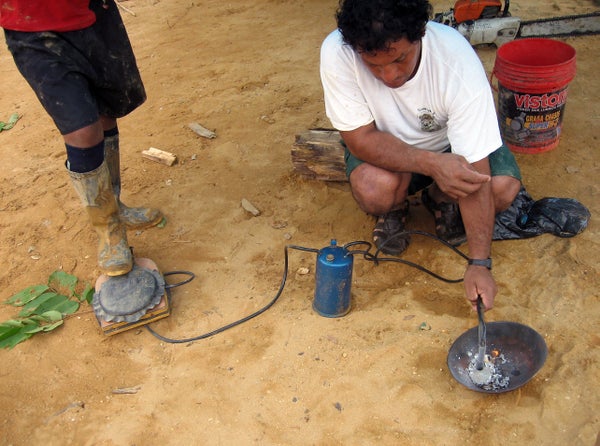
Long-running concerns about the environmental effects of gold-mining in the Peruvian Amazon came to a head last week. Peru’s government declared a 60-day public-health emergency on May 23 in an attempt to address the problem of mercury pollution caused by unregulated gold-mining along the Madre de Dios River.
Health-care and emergency workers will this week begin providing medical and food aid for 25 affected villages, after a flurry of studies showed high levels of mercury in people, fish and sediments in the Madre de Dios region. The government estimates that some 48,000 people across 85,301 square kilometres have been affected.
“We now know with certainty what the source of the exposure is,” says Peru’s deputy health minister, Percy Minaya. “We are not going to solve this in two months, or even in a year, but the Health Ministry has to start.” Symptoms of mercury poisoning include vomiting and diarrhoea. Extreme cases can lead to brain or kidney damage.
On supporting science journalism
If you're enjoying this article, consider supporting our award-winning journalism by subscribing. By purchasing a subscription you are helping to ensure the future of impactful stories about the discoveries and ideas shaping our world today.
The Madre de Dios region has a long history of small-scale alluvial gold-mining, but the rise in international gold prices in the past decade has brought a boom in the activity. Peru’s National Institute of Statistics and Information in Lima reported on May 23 that gold production for March in Madre de Dios was 1,583 kilograms, up 28% from the same month last year.
The region’s miners extract the gold by sluicing sediment to separate gold-bearing sand, which they then mix with mercury to form an amalgamated lump of metal. Heating the lump vaporizes the mercury, leaving pure gold behind. The process sends an estimated 30–40 tonnes of mercury each year into waterways, where bacteria convert the metal into methylmercury. The methylmercury accumulates in fish, which are a key source of food for people in the Madre de Dios region.
Body burden
Perhaps unsurprisingly, researchers at Duke University in Durham, North Carolina, found high levels of mercury (above the maximum recommended by the World Health Organization) in hair samples from 40% of the Madre de Dios residents that they tested. The Duke team has examined about 800 people living along a major highway in the region, 100 people living beside the river and 2,000 in the Amarakaeri Indigenous Reserve.
Some communities in the region are closer to the gold-mining activities than others, but the 40% exposure rate held across the highway, river and reserve, says study leader William Pan, an epidemiologist with Duke’s Global Health Initiative.
The presence of mercury in human hair generally indicates that a person has been exposed to the metal through a dietary source. Pan says that the Duke studies in Madre de Dios show a strong correlation between human mercury exposure and fish consumption. Since 2009, studies by Pan’s group, and by tropical ecologist Luis Fernandez at the Carnegie Institution for Science at Stanford University in California, have found high mercury levels in some species of fish, particularly large catfish and in fish that eat other fish.
Peru’s government used the Duke team’s latest study to determine which riverside communities should receive the emergency aid. Officials are trying to help affected residents to replace the high-risk fish in their diets with other sources of protein. During the emergency period, the government will give food, including canned ocean fish, and multivitamins to combat anaemia, to roughly 15,000 of the 48,000 people affected.
Routes of exposure
Pan says that these steps should reduce the body burden of mercury in people who also cut their consumption of contaminated fish, because the primary route of mercury exposure in the region seems to be through food.
The government is also considering whether its food aid should include supplies of the grain quinoa. Preliminary data from Duke's household surveys in the Madre de Dios region shows a correlation between quinoa consumption and lower mercury levels.
Minaya says that the government’s long-term plan also includes helping communities to establish fish farms. However, the 60-day emergency period is set to end days before a new president—who will be elected on June 5—takes office on July 28. But Minaya is confident that the next administration will continue to monitor and address the mercury pollution problem, despite opposition from regional and local government officials.
They have criticized the emergency decree, arguing that the link between high mercury levels in people and fish consumption in the Madre de Dios region has not been proved. These officials are also worried that the government’s decision to declare a public-health emergency could harm tourism in the nearby Manú National Park and Tambopata National Reserve.
Because of the growing concerns about mercury exposure, Fernandez is leading a project at Wake Forest University in Winston-Salem, North Carolina, to study the metal’s effects on human and environmental health in the Amazon. As director of the Center for Amazonian Scientific Innovation at Wake Forest, Fernandez will lead a team of US researchers who are collaborating with colleagues at the Peruvian Amazon Research Institute and the National Amazonian University of Madre de Dios.
This article is reproduced with permission and was first published on June 1, 2016.