
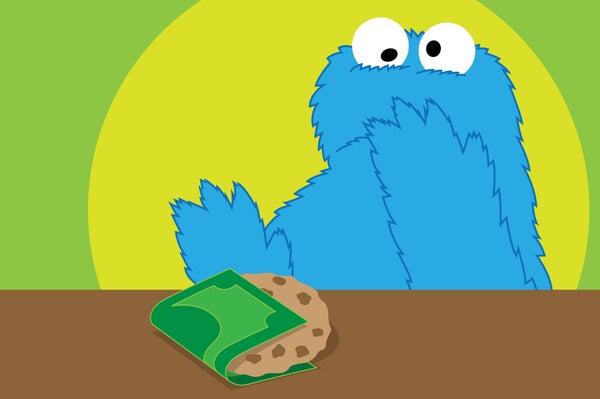
If a stranger offered you a free cookie, you might well eat it. But what if they offered to also give you $2? You might politely decline and walk away thinking, “Something smells fishy.”
In a study published in Personality and Social Psychology Bulletin, researchers found that people tend to turn down offers of “free money,” as well as unusually high salaries or suspiciously cheap services, because they seem “too good to be true.” The research bridges economics and psychology to explain why financial incentives backfire.
In the initial experiment, nearly 40 percent of participants ate a cookie offered freely—compared with about 20 percent of those offered $2 as well. “People typically imagine things like someone did something disgusting to the cookie,” says study lead author Andrew J. Vonasch, a psychological scientist at the University of Canterbury in New Zealand.
On supporting science journalism
If you're enjoying this article, consider supporting our award-winning journalism by subscribing. By purchasing a subscription you are helping to ensure the future of impactful stories about the discoveries and ideas shaping our world today.
Nine further experiments, involving more than 4,000 participants, used online questionnaires to present other scenarios. These included being offered money to accept a ride home, outrageously high construction-job wages and surprisingly cheap flights. In each case, past a certain threshold, higher potential monetary gain reduced participants’ likelihood of accepting the offer.
Vonasch says the study illustrates that contrary to the “standard economic model,” which supposes humans always seek to maximize gains, transactions need to also be understood as social interactions between people trying to understand each other’s minds.
If someone seems to violate accepted norms, such as self-interest, without any explanation, we assume they have hidden motives and infer there will be “phantom costs”: imagined consequences that reduce what Vonasch calls an offer’s “psychological value.”
Factors beyond the present moment may come into play. “Understanding that others’ perceived overgenerosity may put us in their debt could also help explain people’s reluctance,” says Rachel McCloy, a psychologist studying decision-making at England’s University of Reading. “The old maxim ‘there’s no such thing as a free lunch’ is clearly alive and well.”
Another experiment found that high scorers on measures of distrust inferred more phantom costs. The researchers also showed how to mitigate the effect: simply provide a reason for the deal. The “cheap flights” experiment included a condition where the seats were revealed to be very uncomfortable. “Uncomfortable seats aren’t typically a selling point,” Vonasch says. “But telling people the seats were uncomfortable made them more willing to take them because it was sufficient explanation.”
The scientists are now experimenting with whether phantom costs play into humans’ interactions with robots and artificial intelligence. “If AI is overly generous, will people imagine phantom costs?” Vonasch says. “People tend to anthropomorphize and treat [AI agents] as if they have a mind, when obviously they don’t.”