New Issue: Orbital Catastrophe Ahead? Read Now

Mountain photographer stumbles on one of the largest ever collections of Triassic dinosaur prints

A newfound site in the Italian Alps holds one of the largest collections of Triassic dinosaur footprints ever seen

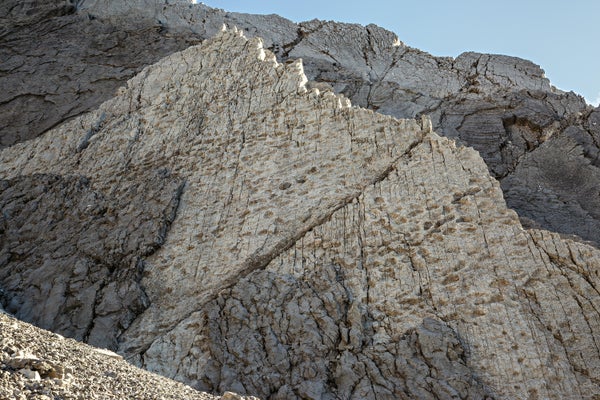
Image of new paleontological site

About 2,000 fossil footprints appear on this part of the mountain site’s walls, researchers say.

Elio Della Ferrera/PaleoStelvio Arch. (PNS, MSNM, SABAP CO-LC)

Join Our Community of Science Lovers!

Last September photographer Elio Della Ferrera spotted thousands of dinosaur tracks traversing vertical rock faces in the Fraele Valley of Stelvio National Park, high in the Italian Alps. Some of the prints, spanning as many as 40 centimeters across, date back about 210 million years, making the newly identified site one of the richest deposits of Triassic dinosaur tracks in the world.

The footprints are so well preserved that “it took me a few seconds to realize the photos were real,” says paleontologist Cristiano Dal Sasso of the Natural History Museum of Milan, who is leading the investigation of the site. “Now we can go back in time and study the evolution of dinosaurs in this place.”

In a preliminary study, Dal Sasso and his team deduced that the prints were made by herds of large, herbivorous dinosaurs, probably prosauropods, ancestors of Jurassic sauropods such as Brontosaurus. The tracks formed when dinosaurs walked across muddy tidal flats along the shores of the prehistoric Tethys Ocean, long before the Alps rose.


On supporting science journalism

If you're enjoying this article, consider supporting our award-winning journalism by subscribing. By purchasing a subscription you are helping to ensure the future of impactful stories about the discoveries and ideas shaping our world today.


Studying this newly named “Triassic Park” will be challenging because it is so difficult to access, Dal Sasso says—researchers will have to rely on drones and remote sensing to study and digitally preserve the footprints.

Two people looking up at a slab of rock with dinosaur footprints.

Some of the best-preserved fossilized footprints at the newfound site show impressions of the Triassic walkers’ long heels, toes and claws.

Elio Della Ferrera/PaleoStelvio Arch. (PNS, MSNM, SABAP CO-LC)

Humberto Basilio is a Mexican science journalist covering policy, health, misconduct, archaeology and the environment. He is also a former news intern at Scientific American. His work has been published in the New York Times, National Geographic, Science, Nature, and more.

More by Humberto Basilio
Scientific American Magazine Vol 334 Issue 3This article was published with the title “Triassic Park” in Scientific American Magazine Vol. 334 No. 3 (), p. 50
doi:10.1038/scientificamerican032026-6JG230lf7I0OybtjFIpoKb

Subscribe to Support Independent Journalism

Great science journalism requires human expertise, time, effort and creativity. And it costs money. That’s why I and the journalists here at Scientific American hope you’ll join our community.

When you subscribe, you are supporting staff and freelance journalists who are passionate about telling science stories that are true, important and compelling. Our editors and reporters are often experts in their fields, which means they understand the nuances of big discoveries and can untangle the breakthroughs from the hype. With a subscription, you are also supporting rigorous fact-checking to ensure the words we publish are precise and accurate. And you’re supporting original illustrations, graphics and photos that bring you closer to an advanced laboratory, an ice sheet in Antarctica or a space mission in orbit. You’re helping us craft other types of high-quality journalism as well: Our newsletters are carefully written, edited and curated by staffers you have or will come to know and love. Our Science Quickly podcast is based on original reporting, collaboration with editors and scientists and exacting production.

Subscriptions keep this engine running so we can continue to deliver thoughtful, rigorous and independent science journalism to you. In an era of viral misinformation, this work is crucial. If you value what we do, I hope you’ll consider joining us as a subscriber

Thank you,

Jeanna Bryner, Editor in Chief, Scientific American

Subscribe