
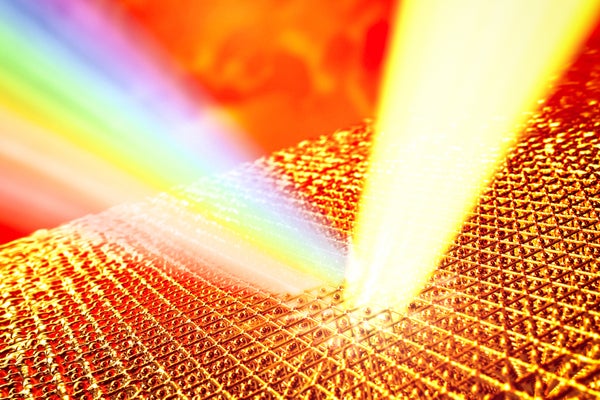
Gold usually melts at 1,300 kelvins—a temperature hotter than fresh lava from a volcano. But scientists recently shot a nanometers-thick sample of gold with a laser and heated it to an astonishing 19,000 kelvins (33,740 degrees Fahrenheit)—all without melting the material. The feat was completely unexpected and has overturned 40 years of accepted physics about the temperature limits of solid materials, the researchers report in a paper published in the journal Nature. “This was extremely surprising,” says study team member Thomas White of the University of Nevada, Reno. “We were totally shocked when we saw how hot it actually got.”
The measured temperature is well beyond gold’s proposed “entropy catastrophe” limit, the point at which the entropy, or disorder, in the material should force it to melt. Past that limit, theorists had predicted solid gold would have a higher entropy than liquid gold—a clear violation of the laws of thermodynamics. By measuring such a blistering temperature in a solid in the new study, the researchers disproved the prediction. They realized that their solid gold was able to become so superheated because it warmed incredibly quickly: their laser blasted the gold for just 45 femtoseconds, or 45 quadrillionths of a second—a “flash heating” that was far too fast to allow the material time to expand and thus kept the entropy within the bounds of known physics.
“I would like to congratulate the authors on this interesting experiment,” says Sheng-Nian Luo, a physicist at Southwest Jiaotong University in China, who has studied superheating in solids and was not involved in the new research. “However, melting under such ultrafast, ultrasmall, ultracomplex conditions could be overinterpreted.” The gold in the experiment was an ionized solid heated in a way that may have caused a high internal pressure, he says, so the results might not apply to normal solids under regular pressures. The researchers, however, doubt that ionization and pressure can account for their measurements. The extreme temperature of the gold “cannot reasonably be explained by these effects alone,” White says. “The scale of superheating observed suggests a genuinely new regime.”
On supporting science journalism
If you're enjoying this article, consider supporting our award-winning journalism by subscribing. By purchasing a subscription you are helping to ensure the future of impactful stories about the discoveries and ideas shaping our world today.
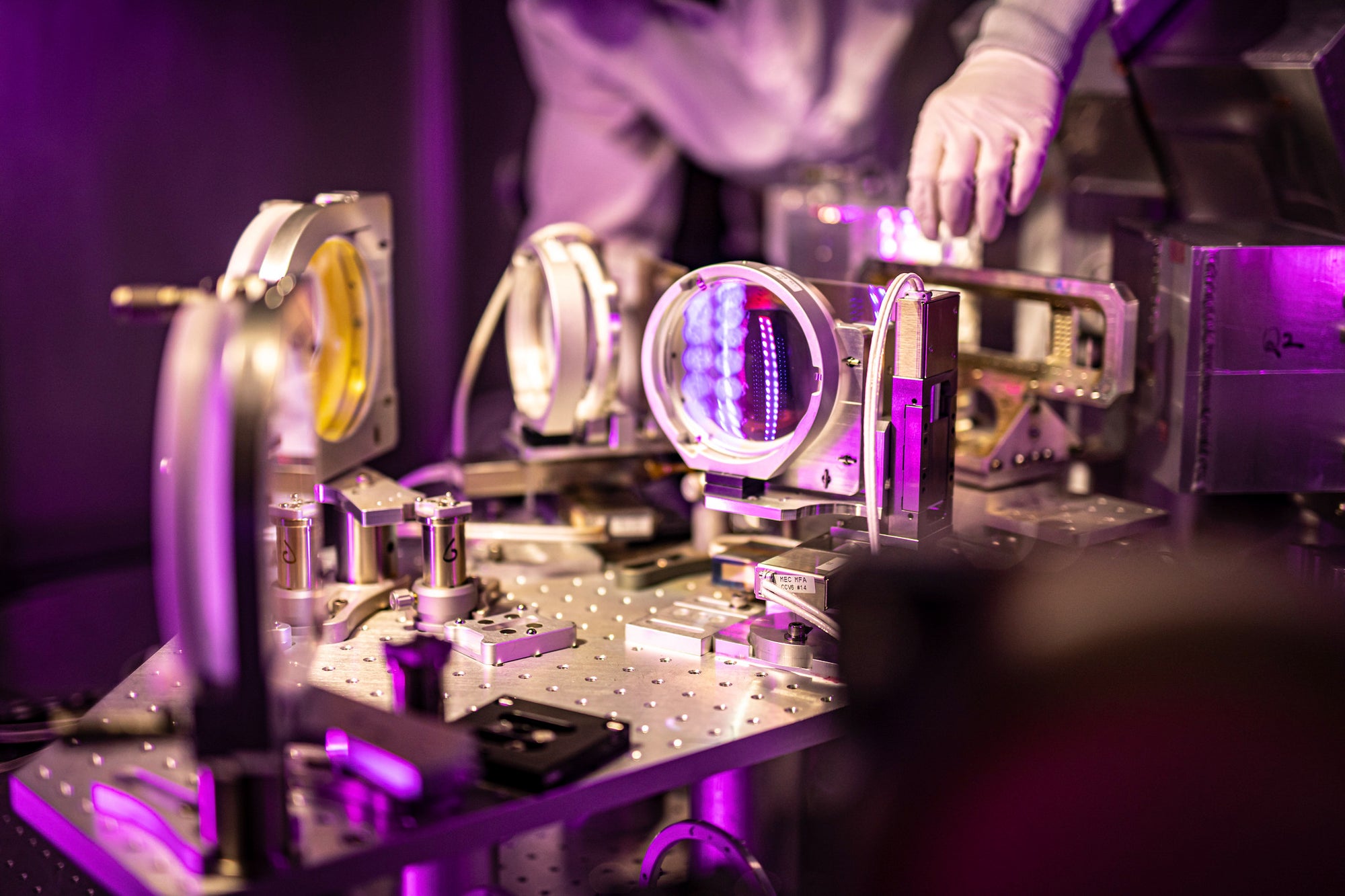
Project Scientist Chandra Curry works at the Linac Coherent Light Source at SLAC National Accelerator Laboratory.
Jacqueline Ramseyer Orrell/SLAC National Accelerator Laboratory
To take the gold’s temperature, the team used another laser—in this case, the world’s most powerful x-ray laser, which is three kilometers (1.9 miles) long. The machine, the Linac Coherent Light Source at the SLAC National Accelerator Laboratory in California, accelerates electrons to more than 99 percent the speed of light and then shoots them through undulating magnetic fields to create a very bright beam of one trillion (1012) x-ray photons.
When this laser fired at the superheated sample, the x-ray photons scattered off atoms inside the material, allowing the researchers to measure the atoms’ velocities to effectively take the gold’s temperature.
“The biggest lasting contribution is going to be that we now have a method to really accurately measure these temperatures,” says study team member Bob Nagler, a staff scientist at SLAC. The researchers hope to use the technique on other types of “warm dense matter,” such as materials meant to mimic the insides of stars and planets. Until now, they’ve had no good way to take the temperature of matter in such toasty states, which usually last just fractions of a second. After the gold trial, the team turned its laser thermometer on a piece of iron foil that had been heated with a laser shock wave to simulate conditions at the center of our planet. “With this method, we can determine what the melting temperature is,” Nagler says. “These questions are super important if you want to model the Earth.”
The temperature technique should also be useful for predicting how materials used in fusion experiments will behave. The National Ignition Facility at Lawrence Livermore National Laboratory, for example, shoots lasers at a small target to rapidly heat and compress it to ignite thermonuclear fusion. Physicists can now determine the melting point for different targets—meaning the whole field could be heating up in the near future.