
Bats are known for using high-frequency acoustic signals to deftly snatch flying insects from the air at night, even amid dense forests. But more than 40 percent of insectivorous bat species hunt by plucking prey resting on leaves or other surfaces. Because the sound waves bats emit reflect off vegetation at all angles, the returning jumble of echoes should render a leaf-bound insect virtually imperceptible—so scientists have long suspected that bats use clues from vision, smells or prey-generated sounds to help find a motionless meal.
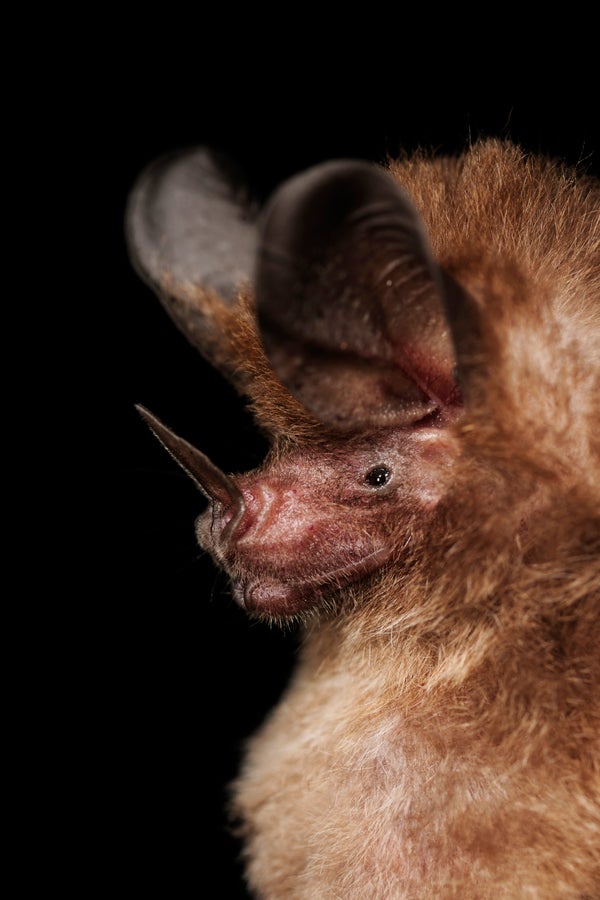
Now, however, biologists Inga Geipel of the Smithsonian Tropical Research Institute, Ralph Simon of Free University Amsterdam and their colleagues have shown how some bats detect a still and silent insect on a leaf using echolocation alone. By approaching the target along a specific trajectory, the common big-eared bat Micronycteris microtis treats the leaf as an acoustic mirror to reflect unwanted echoes away from its angle of attack. This makes the insect's signal stand out, according to a study published in August in Current Biology.
“To the bat's ears, echoes from the prey are enhanced, while those coming from the leaves are effectively reduced,” says John Ratcliffe, an animal biologist from the University of Toronto, who was not involved in the new work.
On supporting science journalism
If you're enjoying this article, consider supporting our award-winning journalism by subscribing. By purchasing a subscription you are helping to ensure the future of impactful stories about the discoveries and ideas shaping our world today.

Credit: Brown Bird Design
The researchers lined a room with microphones and monitored how sound waves generated by a synthetic batlike sonar reflected off a leaf. They found that the waves bounced off the leaf itself in a direction away from the source. But when an insect was placed on the leaf, pulses coming in at angles around 60 degrees from vertical reflected back to the sonar's source. Next the researchers filmed four wild bats nabbing dragonflies perched on leaves. “The bats approached exactly from the expected angles,” Simon explains. Outside of that range of angles, the target became much harder to detect.
This is not the first time scientists have observed bats bouncing waves off a surface in this way; individuals feeding at lakes and ponds use a similar process to help make floating prey stand out. But that tactic relies on the water's large, smooth surface—and bats do not have to maneuver as delicately to approach from the correct angle. “It's exciting to learn that the same process can be exploited in a very different environment,” says neuroscientist Michaela Warnecke of the University of Wisconsin–Madison, who has investigated echolocation but was not involved in the study.
Whether M. microtis's hunting strategy is unique among bat species remains to be seen, Ratcliffe says. But this work helps to reveal the bat's acoustic world, which could lead to new applications, including improved bat-inspired sonar systems, according to the study's researchers.