
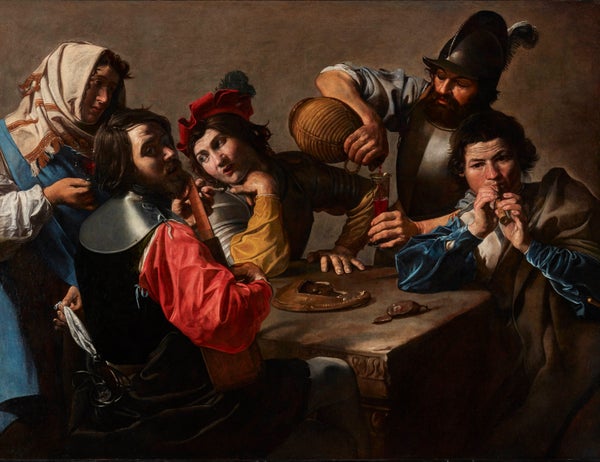
“In wine there is truth,” to cite a proverb quoted by Pliny the Elder—truth about humans, that is. Wine has been a staple of human drinking for thousands of years: it is captured in the frescoes in Pompeii and celebrated in epic poems such as the Iliad and the Odyssey. It was found inside King Tut’s tomb and in trace amounts on 9,000-year-old Chinese pottery and was written about in the Bible. But despite wine’s ubiquity and enduring popularity, scientists have struggled to place exactly when and how humans first made the beverage as we might recognize it today.
And now a new study of ancient grape seeds found across France adds to the puzzle, revealing that humans have been consuming at least one grape variety for hundreds of years. The research was published on Tuesday in the journal Nature Communications.
Researchers analyzed the DNA of nearly 50 wild and domestic grape seeds collected at archaeological sites mostly across France. The pips dated from around 2300 B.C.E. to C.E. 1500, or from the Bronze Age through the late Middle Ages—a period of nearly 4,000 years.
On supporting science journalism
If you're enjoying this article, consider supporting our award-winning journalism by subscribing. By purchasing a subscription you are helping to ensure the future of impactful stories about the discoveries and ideas shaping our world today.
Comparing the DNA of these pips and that of modern wine varietals revealed a “very surprising” finding, says Ludovic Orlando, the study’s senior author and research director of the Center for Anthropobiology and Genomics of Toulouse at the University of Toulouse in France. Some of the ancient grapes had been cloned.
Starting in the mid-Iron Age (around 500 B.C.E.), some of the grape seeds had the same or highly similar DNA. That means that winemakers across what is now France must have switched from domesticating wild grapes to propagating them directly—that is, cloning grapevines by taking cuttings of the plants to start new groves. The results shed more light on the history of wine in France, a region that is world-famous for its wine, as well as across the globe.
Interestingly, one of the cloned grape samples dating back to medieval times was “genetically identical” to pinot noir, a grape widely grown throughout the world today, Orlando says.
“We found the very same plant, 600 years ago in the 15th century,” Orlando says, “the century of Joan of Arc.” What this means is that not only has pinot noir endured in popularity for centuries but people liked it so much that they haven’t changed it much over all that time. “They kept it as it was, propagated as a clone—as a photocopy—for centuries, literally,” he says.
As to whether today’s pinot noir wine tastes the same as whatever medieval knights were knocking back in the French royal court at Paris, grape DNA can’t reveal much about flavor. Wine is a multifaceted product of grape variety, the fermentation process, the environment and additives.
“Wine is a complex biocultural product,” Orlando says. But the DNA may illuminate some aspects, like sugar content and grape size. Ultimately, there is much to learn about the history of wine and—as Pliny the Elder wrote—us.
“Wine and grapes are biological and cultural. Think about which your favorite wine or my favorite wine—it tells something about you, as well as about your culture,” Orlando says.