
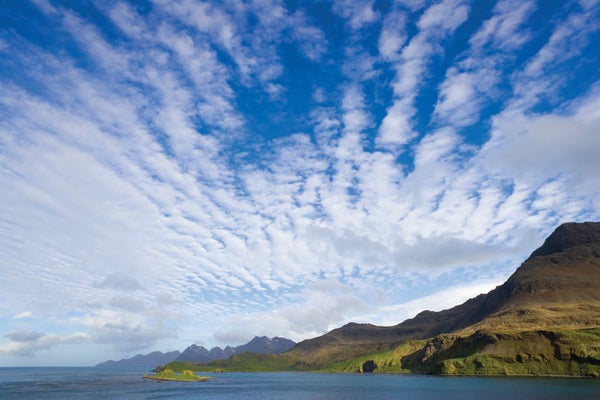
After sunlight completes its eight-minute journey to Earth, white surfaces such as clouds send much of it bouncing right back into space. The whiter and brighter the cloud, the better it is at reflecting sunlight—and at keeping Earth cool. Now, a study published in Atmospheric Chemistry and Physics examines a surprising part of this process: how tiny aquatic creatures known as phytoplankton play a big role in whitening Earth's clouds.
Scientists used satellites to monitor the skies above a large swath of the Southern Ocean for five years. They found that clouds forming south of 60 degrees latitude—that is, closer to Antarctica—tended to be significantly whiter than clouds farther north.
The reason? Minuscule ocean phytoplankton, says University of Utah atmospheric scientist Gerald Mace, the study's lead author. The Antarctic is “a very highly productive region” where tiny creatures such as phytoplankton proliferate more than they do in seas farther north, he says. As part of their metabolism, many of these sunlight-consuming organisms release a compound called dimethyl sulfide, which rises and reacts with gases in the atmosphere to form small aerosol particles—and, eventually, clouds.
On supporting science journalism
If you're enjoying this article, consider supporting our award-winning journalism by subscribing. By purchasing a subscription you are helping to ensure the future of impactful stories about the discoveries and ideas shaping our world today.
Water vapor typically must first bind to a “seed” particle to condense into cloud droplets, says Max Planck Institute for Chemistry biogeochemist Meinrat Andreae, who was among the first to study phytoplankton's cloud-seeding abilities but was not involved in the new study. South of 60 degrees latitude, abundant phytoplankton generate plenty of dimethyl sulfide seeds—so clouds that form there are full of tiny water droplets.
In more northern areas, cloud-forming seeds are less common—“mostly just salt particles that get swept up from ocean spray,” says University of Utah atmospheric scientist and study co-author Sally Benson. The resulting clouds have fewer and bigger droplets, providing less surface area to reflect back sunlight than southern clouds' many small droplets, the researchers say.
The study also found that phytoplankton populations, measured by satellite views of the green compound chlorophyll in the water, peak every summer—soon followed by peaks in cloud reflectiveness. Mace notes that phytoplankton's role in this process is a global phenomenon, but the effect is clearest in the Southern Ocean with its plentiful plankton population and low level of human influence.
Although phytoplankton's involvement in cloud whitening has been known for some time, Andreae says that existing climate models still lack sufficient data to fully account for its effects. He adds that a study of this scale—monitoring a large ocean region over five years—helps to illuminate new patterns, such as the strong link between cloud whiteness and latitude. “With a study of this size,” he says, “we can definitely plug better information into our models.”