
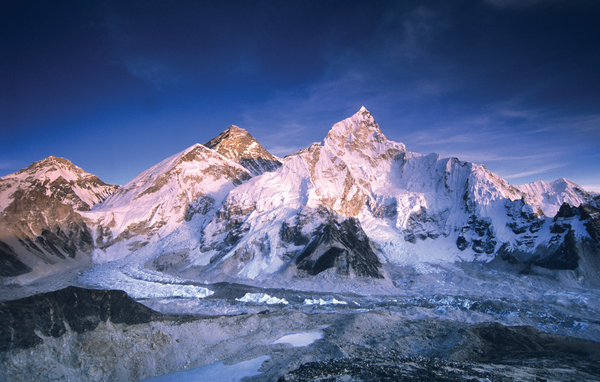
The upper slopes of Mount Everest are a punishing place for plant life: high levels of ultraviolet radiation scorch the mountain, temperatures regularly fall below freezing, and the icy, rocky terrain can hardly be called good soil. But now scientists have identified three new plant species capable of surviving this kind of place. Among the highest-elevation plants known to science, the specimens—collected decades ago but never studied until now—reveal unique adaptations to life on the roof of the world.
On May 25, 1952, a Swiss expedition gathered three plant samples on Everest at roughly 6,400 meters. (The summit, which was first reached the following year, is 8,848 meters.) The dried specimens were placed in an herbarium in Geneva and sat forgotten until 2017, when Cédric Dentant, a botanist at Écrins National Park in Gap, France, rediscovered them.
Dentant carefully analyzed the plants—each no more than a few centimeters long—and found several attributes that most likely contributed to their survival in such harsh surroundings, he reported in October in Alpine Botany. One of the plants had stems that burrowed into the ground, anchoring it in the unstable terrain; another had a cushionlike shape that limited heat and water loss; and two, according to notes made by the 1952 mountaineering team, grew in rock crevices, which are heated by sunlight and are often warmer than the surrounding alpine environment. “We're facing the limit of life,” Dentant says, referring to the extreme conditions in which these plants grew.
On supporting science journalism
If you're enjoying this article, consider supporting our award-winning journalism by subscribing. By purchasing a subscription you are helping to ensure the future of impactful stories about the discoveries and ideas shaping our world today.
Scientists nearly missed out on studying these high-altitude plants, says Sonja Wipf, an alpine plant ecologist at the WSL Institute for Snow and Avalanche Research SLF in Davos, Switzerland. “Not because they were growing on inaccessible rocky ledges,” says Wipf, who was not involved in the new research, “but because they were ‘buried’ in an herbarium.”