
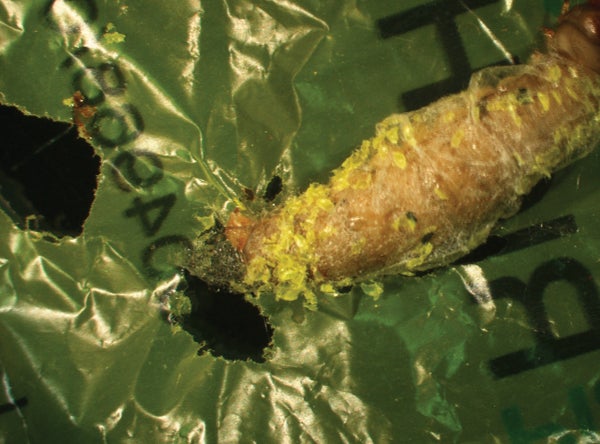
Humans produce more than 300 million metric tons of plastic every year. Almost half of that winds up in landfills, and up to 12 million metric tons pollute the oceans. So far there is no sustainable way to get rid of it, but a new study suggests an answer may lie in the stomachs of some hungry worms.
Researchers in Spain and England recently found that the larvae of the greater wax moth can efficiently degrade polyethylene, which accounts for 40 percent of plastics. The team left 100 wax worms on a commercial polyethylene shopping bag for 12 hours, and the worms consumed and degraded about 92 milligrams, or roughly 3 percent, of it. To confirm that the larvae's chewing alone was not responsible for the polyethylene breakdown, the researchers ground some grubs into a paste and applied it to plastic films. Fourteen hours later the films had lost 13 percent of their mass—presumably broken down by enzymes from the worms' stomachs.
When inspecting the degraded plastic films, the team also found traces of ethylene glycol, a product of polyethylene breakdown, signaling true biodegradation. Their findings were published earlier this year in Current Biology.
On supporting science journalism
If you're enjoying this article, consider supporting our award-winning journalism by subscribing. By purchasing a subscription you are helping to ensure the future of impactful stories about the discoveries and ideas shaping our world today.
Study co-author Federica Bertocchini, a biologist at Spain's Institute of Biomedicine & Biotechnology of Cantabria, says the larvae's ability to break down their dietary staple—beeswax—also allows them to degrade plastic. “Wax is a complex mixture of molecules, but the basic bond in polyethylene, the carbon-carbon bond, is there as well,” she explains. “The wax worm evolved a mechanism to break this bond.”
Jennifer DeBruyn, a microbiologist at the University of Tennessee, who was not involved in the study, says it is not surprising that an organism evolved the capacity to degrade polyethylene. But compared with previous studies, she finds the speed of biodegradation in this one exciting. The next step, DeBruyn says, will be to pinpoint the cause of the breakdown. Is it an enzyme produced by the worm itself or by its gut microbes? Bertocchini agrees and hopes her team's findings might one day help harness the enzyme to break down plastics in landfills, as well as those scattered throughout the ocean. But she envisions using the chemical in some kind of industrial process—not simply “millions of worms thrown on top of the plastic.”