
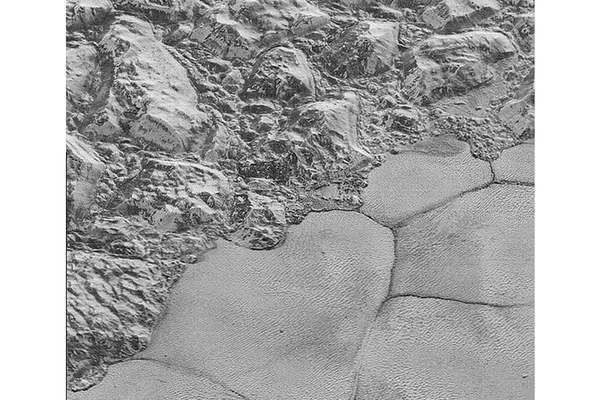
Pluto is an uncanny-valley world, with landscapes and vistas that seem strikingly similar to those of Earth—until you take a closer look.
NASA’s New Horizons mission, which flew by the dwarf planet in July 2015, found that Pluto has towering mountains, but of water ice rather than rock; vast plains of frozen nitrogen and other exotic materials; and blue skies provided by a wispy atmosphere that contains no appreciable oxygen.
And now, a new study reveals another alien parallel: Pluto has an extensive dune system, but the grains that make up the wind-blown mounds are certainly not sand. [Destination Pluto: NASA’s New Horizons Mission in Pictures]
On supporting science journalism
If you're enjoying this article, consider supporting our award-winning journalism by subscribing. By purchasing a subscription you are helping to ensure the future of impactful stories about the discoveries and ideas shaping our world today.
The new discovery “shows us that Pluto’s atmosphere and surface are interacting in a way that geologically/geomorphologically alters the surface,” said study lead author Matt Telfer, a lecturer in physical geography at the University of Plymouth in England.
“That’s exciting not just because it shows (again) the dynamism of these small, cold, dark distant worlds, but also for its inferences for very early solar system bodies,” Telfer told Space.com via email.
Where mountains meet the plain
Telfer and his colleagues analyzed the imagery New Horizons captured during its epic flyby. They noticed a complex of ridges within Sputnik Planitia, a 620-mile-wide (1,000 kilometers) nitrogen-ice plain that forms the left lobe of Pluto’s famous “heart.”
The ridges ripple in a 47-mile-wide (75 km) sliver on the western edge of Sputnik Planitia, where the plain runs into the 3-mile-high (5 km) Al-Idrisi Montes mountain range. The newly identified features look a lot like wind-sculpted dunes, and that’s exactly what they are, according to the study team.
“We’re sure,” Telfer said. “It’s actually the relatively simple stuff, like their location, alignment (undisturbed by glacial movement, unlike the sublimation pits elsewhere), orientation (including the adjacent orthogonal wind streaks), and changes in regional orientation and spacing that nail it. It all makes perfect sense for dunes, and doesn’t match what we’d see for sublimation pits.”
“Sublimation pits” are spots where sunlight has caused relatively large amounts of icy material to sublime, or transition directly from the solid phase to gas. New Horizons imagery has revealed thousands of such depressions across Sputnik Planitia, and a series of aligned pits was the most viable alternative explanation for the dune features, Telfer and his colleagues wrote in the new study, which was published online today (May 31) in the journal Science.
Sublimation is an important part of the dunes’ story, the researchers found. They performed modeling work that suggested Pluto’s winds are strong enough to create the Sputnik Planitia dune system—as long as the grains being blown were already airborne. Sublimation is pretty much the only way to make this happen, with the grains being lofted by rising gas, according to the study team.
The wind-blown grains are probably frozen methane that originated in the nearby mountain range, but bits of nitrogen ice are another possibility, the authors wrote.
The paucity of craters speckling Sputnik Planitia shows that the ice plain’s surface has been shaped by geological activity recently. And the dunes are likely young as well; the study team believes they formed within the past 500,000 years or so. [Pluto’s Heart: A Cosmic Valentine in Photos]
A surprising find
Dune systems appear to be common throughout the solar system. Such features have been confirmed on Earth, Mars, Venus and Saturn’s huge moon Titan, for example, and they may even exist on Comet 67P/Churyumov-Gerasimenko, which was studied up close by Europe’s Rosetta mission from 2014 through 2016.
Still, finding dunes on Pluto was unexpected, given the dwarf planet’s very thin air, experts said.
“What makes this discovery surprising is that the sediment can be mobilized despite Pluto’s tenuous atmosphere, with a surface pressure (1 Pa) that is a factor of 100,000 times lower than that on Earth,” Alexander Hayes, an assistant professor of astronomy at Cornell University who was not involved in the new study, wrote in an accompanying “Perspectives” piece in the same issue of Science.
Telfer expressed similar sentiments: “It was hard to see how the wind could influence anything, until you do the math.”
The new study is far from the final word on Pluto’s dunes, stressed Hayes, who also directs Cornell’s Spacecraft Planetary Imaging Facility.
“Nature tends to converge toward a set of relatively few forms and generic patterns using a variety of processes,” he wrote. “Accordingly, much work is left to do to understand dunes on Pluto. Most notably, it remains to be shown how high the dunes are, when they are most active, whether they change and whether entrainment can occur without lofting.”
New Horizons’ work is far from done, by the way. The probe is now gearing up for a flyby of a small object called 2014 MU69, which lies about 1 billion miles (1.6 billion km) beyond Pluto. That close encounter, which will occur on Jan. 1, 2019, is the centerpiece of New Horizons’ extended mission.
Copyright 2018 SPACE.com, a Purch company. All rights reserved. This material may not be published, broadcast, rewritten or redistributed.