Edited by Dava Sobel
It, too, will be swept away,
but for now on the seabed
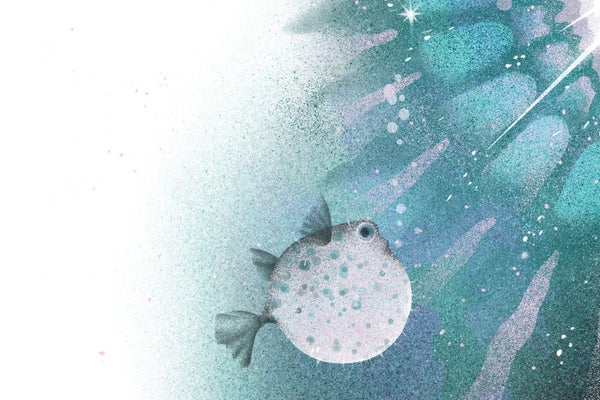
the humble Japanese pufferfish
is creating something
grander than he is alone.
Much as a Tibetan
artist taps his wand to release
a fine stream of sand,
he brushes his fins along the ocean floor
to shift the ancient grains,
On supporting science journalism
If you're enjoying this article, consider supporting our award-winning journalism by subscribing. By purchasing a subscription you are helping to ensure the future of impactful stories about the discoveries and ideas shaping our world today.
stirring up enough dust
for him to vanish
into its clouds, this creature
that’s not much to look at anyway.
Seemingly unremarkable
apart from his labor,
he toils for a week of days and nights
to perfect a shape as symmetrical
as the rose window it resembles.
If that weren’t enough,
before finishing,
with the skill of someone
threading sequins on lace,
he’ll adorn his tracery with seashells,
and swish, swish,
is that a faint signature of fin prints
he’s left on his masterpiece?
Few of us could fail to understand
his loneliness, his longing to be seen,
if only by a she-fish
that comes and goes.
Oh love, that imperfect art
that accompanies us in the depths.
How dark it would be otherwise,
how cold this far under.
Subscribe to Support Independent Journalism
Great science journalism requires human expertise, time, effort and creativity. And it costs money. That’s why I and the journalists here at Scientific American hope you’ll join our community.
When you subscribe, you are supporting staff and freelance journalists who are passionate about telling science stories that are true, important and compelling. Our editors and reporters are often experts in their fields, which means they understand the nuances of big discoveries and can untangle the breakthroughs from the hype. With a subscription, you are also supporting rigorous fact-checking to ensure the words we publish are precise and accurate. And you’re supporting original illustrations, graphics and photos that bring you closer to an advanced laboratory, an ice sheet in Antarctica or a space mission in orbit. You’re helping us craft other types of high-quality journalism as well: Our newsletters are carefully written, edited and curated by staffers you have or will come to know and love. Our Science Quickly podcast is based on original reporting, collaboration with editors and scientists and exacting production.
Subscriptions keep this engine running so we can continue to deliver thoughtful, rigorous and independent science journalism to you. In an era of viral misinformation, this work is crucial. If you value what we do, I hope you’ll consider joining us as a subscriber