New Issue: Orbital Catastrophe Ahead? Read Now

Poem: ‘Baby Crocodile’

Science in meter and verse

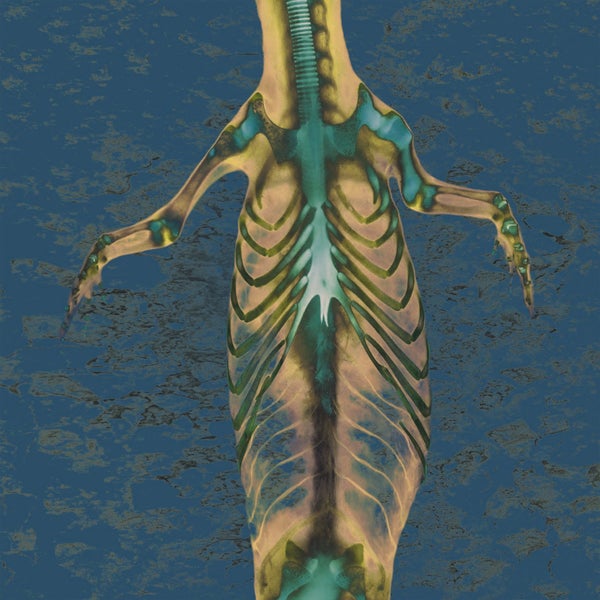
An x-ray image of the body of a young crocodile

Stephen Petegorsky

Edited by Dava Sobel

Tender bones, tiny soul: it could escape
in death in an instant. Itself death-dealer—
mouth of teeth, tyrannosaur
in miniature, an apparently exact copy
of its dozen nestmates—it repeats, too, time.

Yet over its life lurks the great oversoul:
the mother. She hulks. Seems to sleep. Slitty eyes,
creaking limbs, so freighted
with scales and bulk as to appear unmovable,
she tolerates our whispering observation


On supporting science journalism

If you're enjoying this article, consider supporting our award-winning journalism by subscribing. By purchasing a subscription you are helping to ensure the future of impactful stories about the discoveries and ideas shaping our world today.


for minutes on end, gaggle of stupid tourists
closer to death than they think.
All at once she shifts. Someone has edged
too close, camera at the ready, leaning.
Her monstrous shape lunges,
wedge-head swinging, fixing

us with reptilian glare:
hard, cold, glittering, driving
as a Cadillac, and seeming as emotionless.
But that's the thing with life, we're all
the same. Repeated instances

of the same thing. This mother
is me, the surging swamp
within her the same that boils
from my gut, breast, and brain whenever
another small child strips a toy

from my son, or whacks him with a stick;
when a pickup truck cuts the corner
too close as I'm carting my child behind my bike.
Vigilant, monstrous, enormous
guardianship underlain by rage: oh this world

is too much a war, too harsh, is what
each mother, great freight of making, brooks
on the mud by black creek waters or
on the side of a shuddering mattress
when she wrests from the great nothingness a life.

Naila Moreira teaches writing at Smith College and contributes poetry, nature essays and fiction to a variety of publications. Her middle-grade novel The Monarchs of Winghaven is forthcoming from Walker Books.

More by Naila Moreira

Freelance photographer Stephen Petegorsky has exhibited internationally and worked with collections at Harvard's Museum of Comparative Zoology, Yale's Peabody Museum, the Smithsonian, and others.

More by Stephen Petegorsky
Scientific American Magazine Vol 330 Issue 1This article was published with the title “Baby Crocodile” in Scientific American Magazine Vol. 330 No. 1 (), p. 90
doi:10.1038/scientificamerican0124-90

Subscribe to Support Independent Journalism

Great science journalism requires human expertise, time, effort and creativity. And it costs money. That’s why I and the journalists here at Scientific American hope you’ll join our community.

When you subscribe, you are supporting staff and freelance journalists who are passionate about telling science stories that are true, important and compelling. Our editors and reporters are often experts in their fields, which means they understand the nuances of big discoveries and can untangle the breakthroughs from the hype. With a subscription, you are also supporting rigorous fact-checking to ensure the words we publish are precise and accurate. And you’re supporting original illustrations, graphics and photos that bring you closer to an advanced laboratory, an ice sheet in Antarctica or a space mission in orbit. You’re helping us craft other types of high-quality journalism as well: Our newsletters are carefully written, edited and curated by staffers you have or will come to know and love. Our Science Quickly podcast is based on original reporting, collaboration with editors and scientists and exacting production.

Subscriptions keep this engine running so we can continue to deliver thoughtful, rigorous and independent science journalism to you. In an era of viral misinformation, this work is crucial. If you value what we do, I hope you’ll consider joining us as a subscriber

Thank you,

Jeanna Bryner, Editor in Chief, Scientific American

Subscribe