
Edited by Dava Sobel
It is perhaps not strange that the Radiates, a type of animals whose home is in the sea, many of whom are so diminutive in size, and so light and evanescent in substance, that they are hardly to be distinguished from the element in which they live, should have been among the last to attract the attention of naturalists.
They say I came to science
through marriage. As though
I wouldn't have, otherwise.
On supporting science journalism
If you're enjoying this article, consider supporting our award-winning journalism by subscribing. By purchasing a subscription you are helping to ensure the future of impactful stories about the discoveries and ideas shaping our world today.
As though I was dragged, by accident,
like a jellyfish caught in a net.
The truth is I married for science.
It was a way in. Like
a radiate, I got what I wanted
without attracting undue attention.
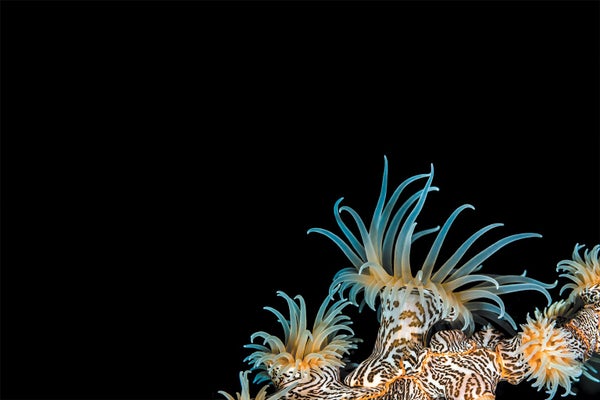
Nothing can be more unprepossessing than a sea-anemone when contracted. A mere lump of brown or whitish jelly, it lies like a lifeless thing on the rock to which it clings, and it is difficult to believe that it has an elaborate and exceedingly delicate internal organization, or will ever expand into such grace and beauty as really to deserve the name of the flower after which it has been called ... the whole summit of the body seems crowned with soft, plumy fringes.
We are all lumps, aren't we, before we find
the thing we love? The things?
My husband and I, lumped together,
blossomed into beauty. I know
that sounds maudlin. Let me try again.
These animals ... thrive well in confinement.
For some women, marriage is a prison.
They enter it willingly. It keeps them
safe from the world. Our marriage
was more like a boat.
They may also multiply by a process of self-division.
We had no children. I took notes.
Another way of saying it is I wrote books.
At every point in our studies
of sea creatures and each other,
I was in charge of the words.
The name Jelly-fish is an inappropriate one, though the gelatinous consistency of these animals is accurately enough expressed by it; but they have no more structural relation to a fish than to a bird or an insect.
Jellyfish are neither jelly nor fish,
as I was not truly wife nor scientist.
Have you seen them move?
It looks as if they move by breathing.
Encountering one of those huge Jelly-fishes, when out in a row-boat one day, we attempted to make a rough measurement of his dimensions upon the spot. He was lying quietly near the surface, and did not seem in the least disturbed by the proceeding, but allowed the oar, eight feet in length, to be laid across the disk, which proved to be about seven feet in diameter. Backing the boat slowly along the line of the tentacles, which were floating at their utmost extension behind him, we then measured these in the same manner, and found them to be rather more than fourteen times the length of the oar...
As I write these lines I remember
that day in the boat and how happy
we were. A person could measure
our happiness in oars. A person could
lay down oar after oar and still need
more oars.
Our laughter echoing over the waves.
No one to hear it besides each other—
and the biggest jellyfish we ever saw.
Author's Note: All italic quotations are from Agassiz's Seaside Studies in Natural History (1865). In addition to her scientific research, Agassiz collaborated with her husband, natural historian Louis Agassiz, on marine expeditions. She was a co-founder and the first president of Radcliffe College.