New Issue: Orbital Catastrophe Ahead? Read Now

Poem: ‘Mendeleev’s Nightmare’

Science in meter and verse

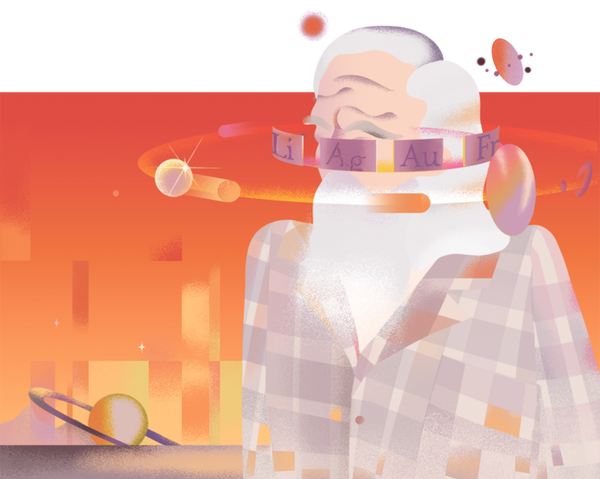
Illustration of a scientist with atomic elements floating in front of his eyes

Olga Aleksandrova

I went to my rest a sober man, content with the stable progression of elements I found to be more reliable than any prayer. Sleep came easily. I went deep, then deeper, until in a single instant I fell straight through the lattice of all-that-is.

Diced, I arrive into this hell scape, my sobriety sieved, irretrievable. A man dressed in black dips the tip of a thin moustache into pot after pot of color. With a theatrical swoop, he renders all-that-was-rectilinear down to violent,
vertiginous curves, which drip like fluorescent tallow

 tock  tock  tock
         off the edge of the known world.


On supporting science journalism

If you're enjoying this article, consider supporting our award-winning journalism by subscribing. By purchasing a subscription you are helping to ensure the future of impactful stories about the discoveries and ideas shaping our world today.


He turns to me and seals my throat with the same, whispers only memory persists. Then, lifting his shoe hat, winks horribly, and recedes at implausible speed toward a doorway newly there. I stumble after him, desperate to find what order might remain.

We stand on the threshold. I could wish my ears stopped with wax. A brass band decibels down the street, while ranks of percussive skeletons dance past bearing aloft faux-gold balloons. They are on their way to the ceremony where what-is-lost (as light and unwilling as any child bride) must wed what-remains-forever. My rage swells. I will find a way to annul this marriage made in hell. Twisting free, I run backwards and slip into an alley where it is dim and the carnival din quietens.

  tap  tap     tap  tap

Have I arrived tongueless, then, in the land of the blind? Slowly my eyes and ears adjust. Up ahead I see street gangs gathered to scry the uncertain future. I draw closer. A young girl crouches, dressed in rags. She stares so fixedly at what is before her that she does not see me. I look over her shoulder, read the words that appear and fade on her handheld screen: How to recover silver from X-rays.

I cough and spit out fractured wax. It is critical I speak.

  The ghosts are in the machine.

Liana Christensen is an Australian poet whose published works include Deadly Beautiful, Wild Familiars and Unnatural History. This poem was inspired by the European Chemical Society’s revised periodic table, depicting element scarcity, which struck Christensen as “Dali-esque.”

More by Liana Christensen
Scientific American Magazine Vol 332 Issue 2This article was published with the title “Mendeleev’s Nightmare” in Scientific American Magazine Vol. 332 No. 2 (), p. 73
doi:10.1038/scientificamerican022025-27u5kfgQF7PDYJsFIU30bP

Subscribe to Support Independent Journalism

Great science journalism requires human expertise, time, effort and creativity. And it costs money. That’s why I and the journalists here at Scientific American hope you’ll join our community.

When you subscribe, you are supporting staff and freelance journalists who are passionate about telling science stories that are true, important and compelling. Our editors and reporters are often experts in their fields, which means they understand the nuances of big discoveries and can untangle the breakthroughs from the hype. With a subscription, you are also supporting rigorous fact-checking to ensure the words we publish are precise and accurate. And you’re supporting original illustrations, graphics and photos that bring you closer to an advanced laboratory, an ice sheet in Antarctica or a space mission in orbit. You’re helping us craft other types of high-quality journalism as well: Our newsletters are carefully written, edited and curated by staffers you have or will come to know and love. Our Science Quickly podcast is based on original reporting, collaboration with editors and scientists and exacting production.

Subscriptions keep this engine running so we can continue to deliver thoughtful, rigorous and independent science journalism to you. In an era of viral misinformation, this work is crucial. If you value what we do, I hope you’ll consider joining us as a subscriber

Thank you,

Jeanna Bryner, Editor in Chief, Scientific American

Subscribe