
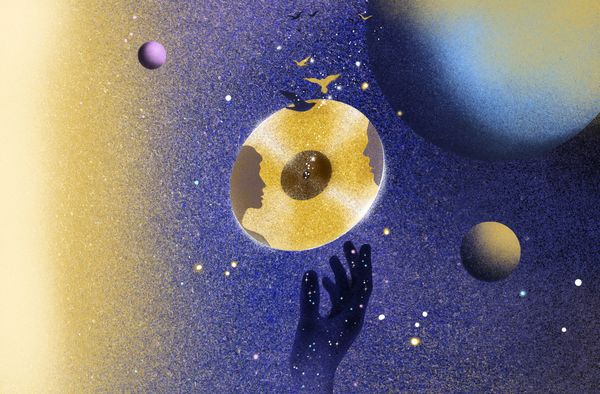
The Golden Record
isn’t fully golden. It’s two gold-plated copper discs
engraved with Earth’s sights and sounds
and welded to Voyagers 1 and 2.
Back then I saw their process on the news
and I wanted to be on that committee—
one of the people who decided
what aliens should hear:
the ocean, bird caws, violins,
a baby’s laugh, hyenas, volcanoes,
traffic, fifty-five languages and six
full seconds of mud pots glugging.
Elementary-school me wouldn’t
have pushed the mud pots,
maybe leaned into koalas and monorails,
but still, I wanted to be Carl Sagan’s heroic secretary
who canvassed all of Ithaca and beyond
to rally native speakers fast, pre-Internet,
and carve their voices into metallic grooves
in that I-want-to-teach-the-world-to-sing spirit
that floated like a rainbow tie-dyed gasoline spill
on the surface of the dark water of the 70s.
On the assumption aliens had eyes,
the committee included pictures: cell division,
a grape-picker, mushrooms, x-rays, rickshaws,
a woman licking a chocolate ice cream cone,
a man grimly eating a sandwich, and
another man drinking from a pitcher as
if he had been lost in the desert for days,
an unpleasantly voracious triptych that might
make a more refined life-form wince.
On supporting science journalism
If you're enjoying this article, consider supporting our award-winning journalism by subscribing. By purchasing a subscription you are helping to ensure the future of impactful stories about the discoveries and ideas shaping our world today.
The records are still out there
more than 11 billion miles from Earth and
40,000 years from another planet,
not even close to each other in interstellar space.
Along with a needle and hieroglyphic instructions
telling them to play it at 16⅔ speed,
they’ll float on with their hosts indefinitely,
until they break apart in the dark
or stop transmitting and become,
officially, space junk.
Even now, I think I know
what people want to hear. Sometimes
I give them what I think they want to see:
the breathing, thinking messy mammal
hidden and refracted into
librarian, scientist, polyglot-wrangler,
frozen smile even bigger than that
Malaysian father holding his daughter,
eternally happy in a picture floating in the dark.
In my head, I consult with a committee constantly.
Does this sound like static? Are these
a code or just random beeps?
I used to believe if you packaged it just right,
anyone could understand you, record player or not.
We’ll be gone before the gold shows up
on what passes for a cosmic doorstep
but there’s still a chance the aliens might understand
we were more than just part of the machinery.