New Issue: Orbital Catastrophe Ahead? Read Now

Poem: ‘The Soliloquy of Schrödinger’s Cat’

A meditation on life and the von Neumann–Wigner interpretation of quantum mechanics

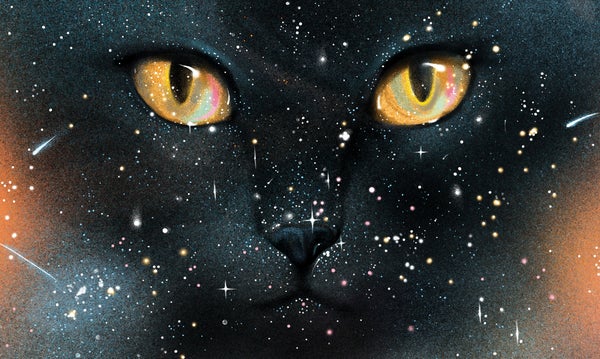
A starfield hangs in front of an illustration of a black cat with shining eyes illustrated by Masha Foya.

Masha Foya

Join Our Community of Science Lovers!


On supporting science journalism

If you're enjoying this article, consider supporting our award-winning journalism by subscribing. By purchasing a subscription you are helping to ensure the future of impactful stories about the discoveries and ideas shaping our world today.


To be and not to be—that is the mystery:
Whether opposing states thus coexist
Until their limbo meets a conscious mind,
Which, by observing, ends it? To look, itself,
Affects what’s seen, for by our sight we end
The many delicate entanglements
That matter’s heir to. ’Tis a constant loss
That cannot be escaped. The smallest acts
May seal our fate in ways none can predict,
For nature charts its course by rolling dice,
With nil regard for our desires or prayers.
Through countless chance events we came to be,
And random luck may hasten our demise.
It falls to us to ease each other’s load
And find such meaning as we can in life.
That we evolved from dust of stars, with minds
Adept at seeking meaning for ourselves,
Should ample meaning be; aye, there’s the rub,
For where’s the line dividing mind from brain
That frees the first from laws of space and time
To act with ghostly power from afar?
O, Erwin, do not chafe at vexing truths
That mock thy core beliefs about the world.
The universe cares naught for thy despair
And cannot bend its nature to thy will.
Its secrets lie beyond the human realm,
Beyond the grasp of common human thought.
That untold wondrous mysteries still abound
To challenge and exalt the greatest minds
Is surely life’s most precious gift of all.

Pippa Storey received an M.Sc. in physics from the University of Auckland in New Zealand and a doctorate in quantum physics from the Université Pierre et Marie Curie in France. She is now a research associate professor of radiology at the New York University School of Medicine, where she develops novel MRI techniques. For more of her writing, visit www.pippastorey.com

More by Pippa Storey
Scientific American Magazine Vol 335 Issue 1This article was published with the title “The Soliloquy of Schrödinger’s Cat” in Scientific American Magazine Vol. 335 No. 1 (), p. 125
doi:10.1038/scientificamerican072026-6hP1FttWGKF5SRTYtkImAr

Subscribe to Support Independent Journalism

Great science journalism requires human expertise, time, effort and creativity. And it costs money. That’s why I and the journalists here at Scientific American hope you’ll join our community.

When you subscribe, you are supporting staff and freelance journalists who are passionate about telling science stories that are true, important and compelling. Our editors and reporters are often experts in their fields, which means they understand the nuances of big discoveries and can untangle the breakthroughs from the hype. With a subscription, you are also supporting rigorous fact-checking to ensure the words we publish are precise and accurate. And you’re supporting original illustrations, graphics and photos that bring you closer to an advanced laboratory, an ice sheet in Antarctica or a space mission in orbit. You’re helping us craft other types of high-quality journalism as well: Our newsletters are carefully written, edited and curated by staffers you have or will come to know and love. Our Science Quickly podcast is based on original reporting, collaboration with editors and scientists and exacting production.

Subscriptions keep this engine running so we can continue to deliver thoughtful, rigorous and independent science journalism to you. In an era of viral misinformation, this work is crucial. If you value what we do, I hope you’ll consider joining us as a subscriber

Thank you,

Jeanna Bryner, Editor in Chief, Scientific American

Subscribe